 English
 العربية

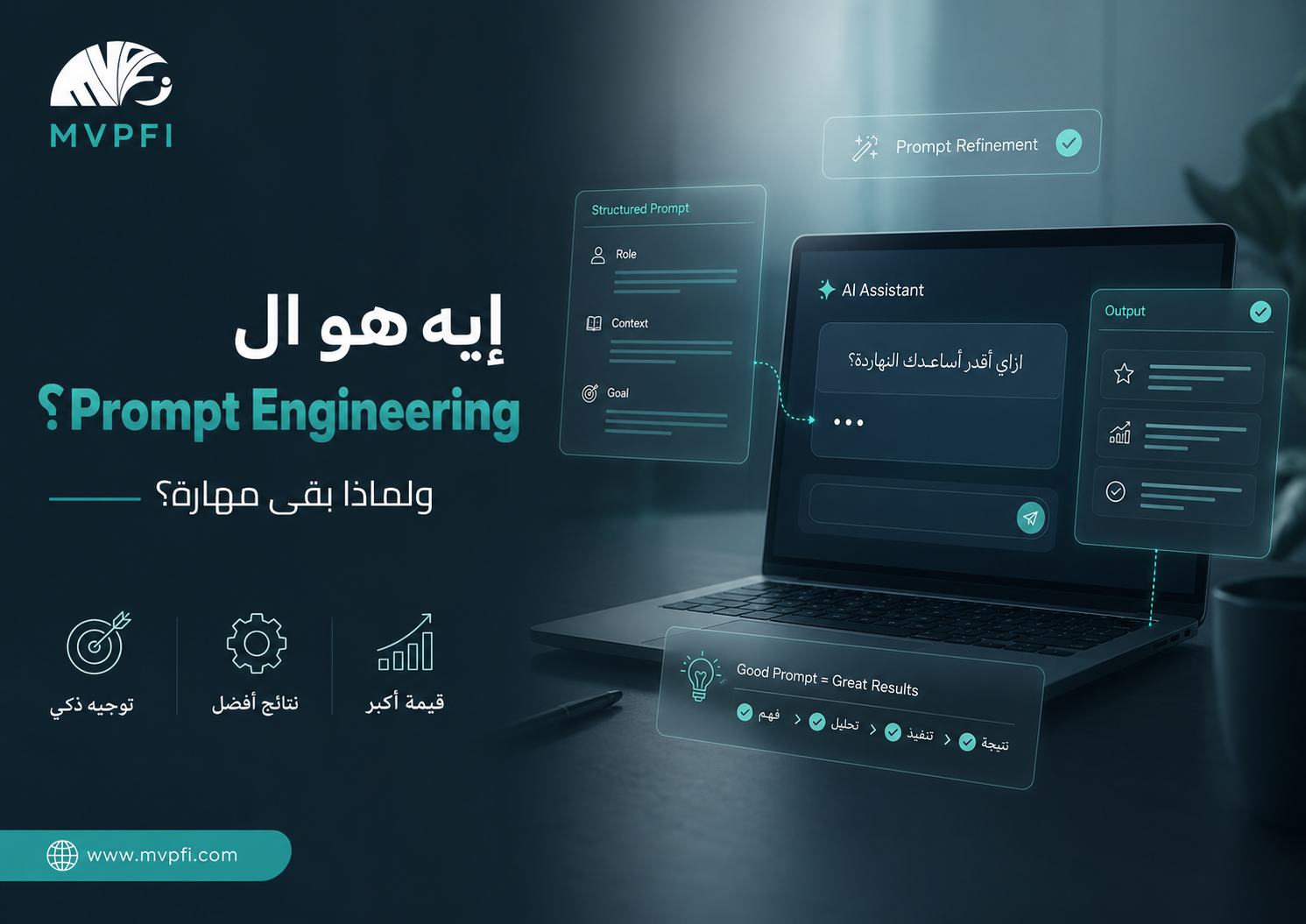
What Is Prompt Engineering and Why Has It Become a Skill?
Prompt Engineering is the skill of writing clear instructions for AI tools so you can get more accurate, faster, and more useful results. With the rise of tools like ChatGPT and Generative AI, this skill is no longer only for developers. It has become important for anyone who wants to use AI effectively at work.
Many people use AI tools and then complain that the results are generic, shallow, or not suitable for their needs. In many cases, the problem is not only the tool itself, but the way the request is written. AI needs clear instructions, enough context, a specific goal, and a defined output format.
This is where Prompt Engineering becomes important. It is not just about writing a question. It is a way of thinking that helps you turn your need into a clear instruction that an AI tool can understand and execute better.
What Is a Prompt?
A Prompt is the question, command, or instruction you give to an AI tool. It can be a simple sentence like “write an ad,” or a detailed request that includes the goal, audience, tone, context, limitations, and required output format.
The clearer and more specific the prompt is, the higher the chance of getting a useful result. The more general or incomplete it is, the more likely the result will be generic or inaccurate.
The quality of AI output often starts with the quality of the instructions you give it.
What Is Prompt Engineering?
Prompt Engineering is the skill of designing and writing prompts in a way that helps AI tools understand the task and produce better outputs.
The idea is not simply to write a long request. The goal is to write a smart request: one that defines the role expected from the tool, explains the context, clarifies the goal, identifies the audience, sets the tone, and describes the final output format.
Prompt Engineering is the difference between using AI as a random tool and using it as a real productivity assistant inside a clear workflow.
Why Has Prompt Engineering Become an Important Skill?
Because AI tools are now part of daily work in marketing, sales, software development, management, customer service, education, analysis, and content creation. But the real value does not come from having access to the tool. It comes from knowing how to ask for what you need.
The Difference Between a Basic Prompt and a Professional Prompt
The difference appears in the details. A general request gives a general answer, while a well-designed prompt guides the tool toward a result closer to what you actually need.
| Basic Prompt | Professional Prompt |
|---|---|
| Write an ad for a weight loss product | Write a short Meta ad for a weight loss product targeting women aged 25 to 40, with a reassuring tone, a strong hook, and no direct medical promises |
| Create a content plan | Create a monthly content plan for a nutrition clinic, with 3 posts per week, divided between awareness, trust-building, common cases, and booking CTA |
| Explain this code | Explain the following code for a junior developer, describe what each part does, identify possible issues, and suggest security and performance improvements |
| Summarize the report | Summarize the report in 5 executive points for management, then extract risks, opportunities, and practical recommendations for next week |
Components of a Good Prompt
There is no single template that fits everything, but most strong prompts share key elements that make the result clearer and more accurate.
Role
Define the role you want the AI to take, such as marketing expert, technical consultant, data analyst, content editor, or project manager.
Context
Explain the background of the task: company type, audience, product, problem, stage, or available data.
Goal
Clarify what you want to achieve: selling, educating, summarizing, analyzing, improving, comparing, or making a decision.
Output Format
Ask for the result in the required format: bullet points, table, code, WhatsApp message, weekly plan, report, or checklist.
Tone and Style
Define whether you want the language to be formal, friendly, simple, technical, persuasive, reassuring, or suitable for social media.
Constraints
Mention what should be avoided: banned words, exaggerated claims, a specific length, complex terms, or platform policy issues.
A Practical Template for Writing a Strong Prompt
You can use the following template as a starting point for many daily business tasks.
Act as [role]. I want you to [task]. The context is [project or audience details]. The goal is [required outcome]. Write in a [tone] style. Format the output as [table / bullet points / code / plan]. Avoid [constraints or mistakes]. Ask me if any essential information is missing.
Prompt Engineering Examples by Specialty
Prompt Engineering is not limited to one field. The same idea can be used in marketing, software development, customer service, management, analysis, and human resources.
Marketing
Write 5 ad ideas for a skincare product targeting women aged 25 to 45, with a trustworthy tone, a short hook, a clear CTA, and no direct medical claims.
Sales
Prepare a follow-up message for a client interested in website development, using a professional and friendly tone, mentioning 3 practical benefits, and ending with an invitation to book a call.
Software Development
Review the following code for security and performance, explain potential issues, then suggest an improved version with clear comments.
Customer Service
Write a response to an angry customer because of a delayed order, using a calm and professional tone, with a clear apology, a practical solution, and a question to continue the follow-up.
Data Analysis
Analyze the following table, extract the top 5 indicators, identify any noticeable increase or decrease, and provide practical recommendations.
Human Resources
Write a job description for an inside sales representative, including responsibilities, required skills, KPIs, and suggested interview questions.
How Does Prompt Engineering Improve Team Productivity?
When every employee uses AI in a random and different way, the results become inconsistent. But when a company has clear prompt templates for each team, speed and quality improve, and outputs become easier to review and improve.
Standardizing Requests
Instead of every employee writing prompts differently, reusable templates are created for each task and brand style.
Reducing Trial Time
Good templates reduce the number of repeated attempts and corrections, saving team time.
Improving Output Quality
Because every prompt includes context, tone, and a clear goal, results become closer to what is needed.
Making Review and Improvement Easier
When templates are documented, they can be improved over time based on output performance.
Common Mistakes When Writing Prompts
Many weak AI results come from incomplete or vague prompts. Knowing the common mistakes helps you quickly improve the quality of your AI usage.
Writing a Very General Request
Requests like “write content” or “make a plan” usually produce generic answers because they do not include enough context.
Not Defining the Audience
Content for a company CEO is different from content for a student, an end customer, or an internal employee.
Not Defining the Output Format
If you do not request a table, bullet list, short message, or specific format, you may get a long text that is not directly usable.
Accepting the Result Without Review
AI can make mistakes, exaggerate, or provide generic answers. Human review is necessary before using the output.
Is Prompt Engineering Only a Technical Skill?
No. Although the term sounds technical, the skill itself is useful for anyone who uses AI tools at work. Marketers need it to write better content, managers need it to summarize meetings, analysts need it to understand data, and developers need it to improve code.
It is a skill that combines clear thinking, domain knowledge, the ability to describe what is needed, and critical review of outputs.
Prompt Engineering is not only a writing skill. It is a thinking, organizing, and directing skill for artificial intelligence.
What Is the Relationship Between Prompt Engineering and Workflow?
The real value appears when AI usage is not just a question-and-answer activity, but part of a clear workflow. For example: collecting data, summarizing, drafting, reviewing, improving, then approving.
In this case, prompts can become reusable company templates and can be connected with CRM systems, ERP systems, project management tools, or internal bots.
| Random Usage | Workflow-Based Usage |
|---|---|
| Every employee writes a different prompt | Standard templates based on department and task |
| Inconsistent results | Outputs closer to company identity and standards |
| No clear measurement | Time, quality, and improvement can be measured |
| Risk of entering sensitive data | Clear rules for what is allowed and what is prohibited |
How Can You Learn Prompt Engineering Quickly?
Learning does not depend only on reading ready-made templates. It depends on structured experimentation. Start with a simple request, review the result, add context, change the tone, define the format, and compare the difference.
Start With a Clear Goal
Before writing the prompt, ask yourself: what result do I want, and who will use it?
Add Context
Mention the industry, audience, data, limitations, tone, and any details that affect the output.
Define the Output Format
Ask for a table, list, message, plan, code, report, or any specific format based on your need.
Review and Improve
Do not treat the first result as final. Ask for a shorter version, clearer explanation, stronger angle, or more specialized output.
Can Companies Build a Prompt Library?
Yes, and this is one of the most practical uses. A company can build an internal prompt library by department: marketing, sales, customer service, management, analysis, HR, and software development.
This library helps standardize quality, save time, train new employees, and protect the company’s tone of voice from random outputs.
Conclusion
Prompt Engineering is the skill of writing and directing AI instructions clearly and specifically to get better results. Its importance has grown because AI tools are now present in most work areas, but effective usage requires clarity, context, and review.
A person or company that knows how to write good prompts will get faster, more accurate, and more usable outputs. Random usage usually produces generic, inconsistent, or heavily edited results.
That is why Prompt Engineering is no longer a side skill. It has become part of modern work skills, especially for any team that wants to bring AI into a real, organized workflow.
Turn Prompts Into Real Workflows That Support Your Team
MVPFI helps businesses build custom prompt templates, design AI workflows, connect artificial intelligence with CRM and ERP systems, train teams on proper usage, and automate repetitive tasks safely and systematically.
Frequently Asked Questions
What is Prompt Engineering?
Prompt Engineering is the skill of writing clear and specific instructions for AI tools to get better and more accurate results.
What does Prompt mean?
A prompt is the question, command, or instruction you give to an AI tool so it can perform a certain task.
Is Prompt Engineering important for non-developers?
Yes. It is important for marketers, managers, analysts, customer service teams, HR, content creators, and not only developers.
What are the key elements of a good prompt?
The most important elements are role, context, goal, audience, tone, output format, and any constraints or things to avoid.
Can weak prompts lead to wrong AI results?
Yes. A vague or incomplete request can lead to generic or inaccurate results, so improving the prompt improves output quality.
Should AI results be reviewed even after writing a good prompt?
Yes. Human review is always necessary because AI can make mistakes or produce content that does not fit the context.
Can a company build a prompt library?
Yes. A prompt library can help standardize quality, speed up work, train teams, and reduce random outputs.
How can MVPFI help with Prompt Engineering?
MVPFI helps design prompt templates, build AI workflows, connect AI with company systems, and train teams on practical and safe AI usage.

Add New Comment