 English
 العربية

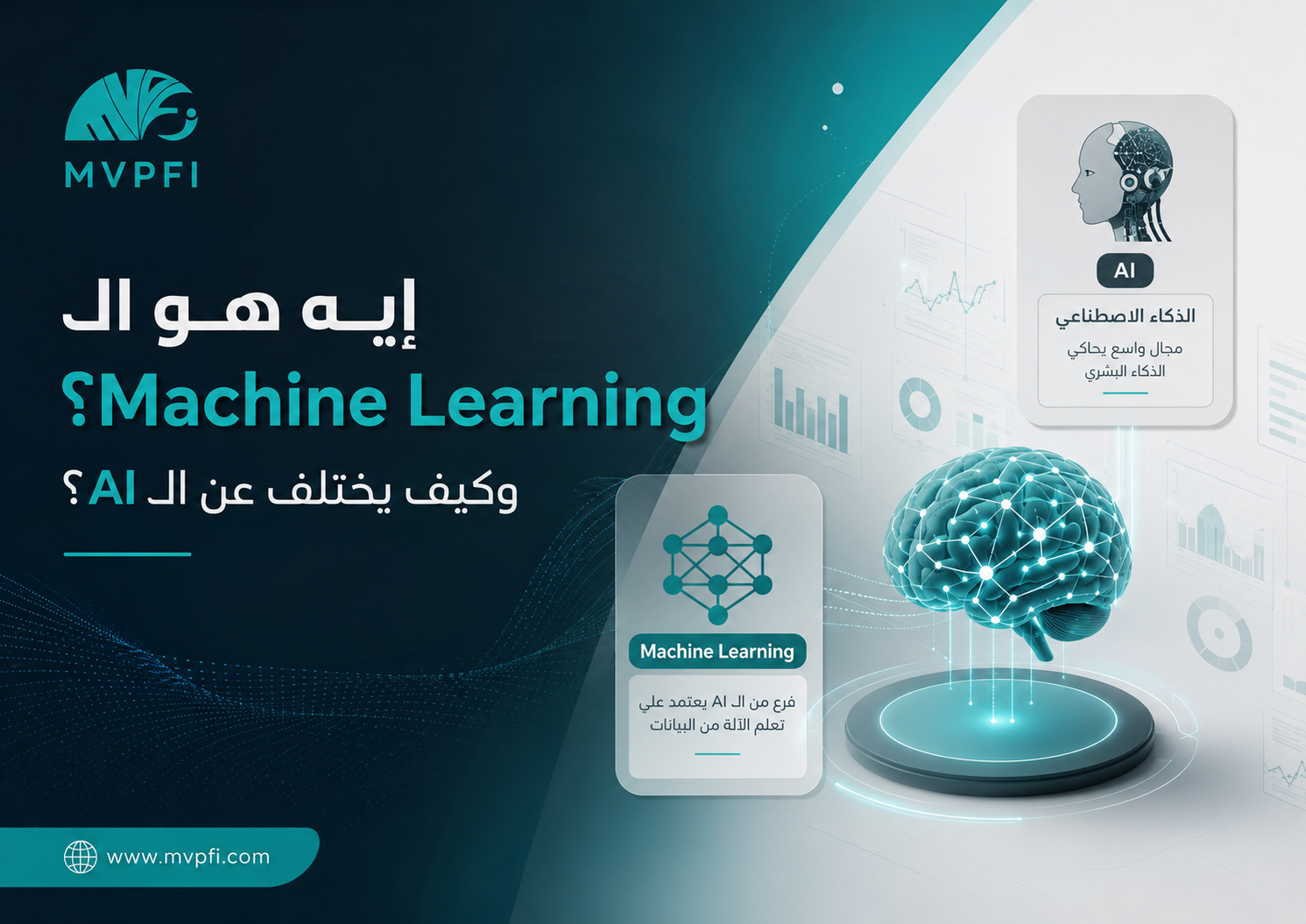
What Is Machine Learning and How Is It Different From AI?
Many people use the terms Artificial Intelligence and Machine Learning as if they mean the same thing. In reality, Machine Learning is one important part of a much larger field called Artificial Intelligence. Understanding the difference helps businesses use technology wisely instead of only following buzzwords.
In recent years, AI has become part of almost every business conversation: marketing, customer service, software development, healthcare, education, sales, and data analysis. But when companies start building real solutions, another important term appears: Machine Learning.
Simply put, Artificial Intelligence is the big idea: making machines perform tasks that usually require human intelligence. Machine Learning is one of the main ways to achieve that by allowing systems to learn from data and improve their results over time.
What Is Artificial Intelligence?
Artificial Intelligence, or AI, is a broad field focused on building systems that can perform tasks that normally require human thinking, understanding, or decision-making. These tasks may include understanding language, analyzing images, answering questions, recommending actions, making predictions, or automating work.
AI is not one single tool. It is a large umbrella that includes many technologies such as Machine Learning, Natural Language Processing, Computer Vision, Expert Systems, Generative AI, robotics, and decision automation.
Artificial Intelligence is the wider goal: making systems behave intelligently. Machine Learning is one of the most important ways to reach that goal.
What Is Machine Learning?
Machine Learning is a branch of Artificial Intelligence that allows systems to learn from data instead of being manually programmed for every possible case.
In traditional programming, a developer writes clear rules: if this happens, do that. In Machine Learning, we provide the system with data, and the model learns patterns and relationships from that data. Then it uses what it learned to predict, classify, recommend, or make decisions.
Instead of writing every rule manually, Machine Learning allows the system to learn rules from data.
Machine Learning vs AI: The Simple Difference
The easiest way to understand the difference is this: Artificial Intelligence is the larger field, while Machine Learning is a part of it. Every Machine Learning solution is AI, but not every AI solution is Machine Learning.
| Comparison | Artificial Intelligence | Machine Learning |
|---|---|---|
| Meaning | A broad field for building systems that behave intelligently | A branch of AI that enables systems to learn from data |
| Scope | Wider and more general | More specific and focused on learning from data |
| Main Idea | Simulating parts of human intelligence | Finding patterns and making predictions based on data |
| Example | A smart assistant that answers customer questions | A model that predicts which customer is likely to buy |
| Data Dependency | May depend on data, rules, models, or logic | Depends mainly on data and training |
A Simple Example to Explain the Difference
Imagine you own an e-commerce store and want a system that helps increase sales. AI can support that goal in different ways, and Machine Learning can be one of the core engines behind some of those solutions.
Smart Customer Assistant
A system that answers customer questions, suggests products, and explains shipping or return policies.
Purchase Prediction
A model that learns from previous customer behavior and predicts who is most likely to buy.
Customer Message Analysis
A system that understands messages and classifies them into complaints, inquiries, orders, or sales opportunities.
Product Recommendations
A model that learns from user behavior and recommends suitable products for each customer.
How Does Machine Learning Work?
Machine Learning works around a simple idea: the better the data, the better the model can learn. But data alone is not enough. It must be collected, cleaned, prepared, modeled, tested, improved, and monitored after deployment.
Data Collection
Data is collected from sources such as sales, customers, websites, internal systems, support tickets, or marketing campaigns.
Data Cleaning
Duplicate records, wrong values, missing data, and inconsistent formats are fixed so the data becomes usable.
Model Training
The model learns from historical data to discover patterns, relationships, and signals that help produce useful outputs.
Testing and Improvement
The model is tested on new data to evaluate accuracy, then improved before being used in real business workflows.
Types of Machine Learning
Machine Learning has several types, and each one is used depending on the business problem and the available data.
Supervised Learning
The model learns from data that includes examples and known answers, such as predicting a product price or classifying a customer as interested or not interested.
Unsupervised Learning
The model explores data without predefined answers and tries to discover patterns, such as grouping customers based on behavior.
Reinforcement Learning
The system learns through actions, feedback, and rewards. It is commonly used in robotics, games, and complex decision systems.
Deep Learning
An advanced type of Machine Learning based on neural networks. It is widely used in images, audio, language, translation, and modern AI applications.
Practical Business Examples of Machine Learning
Machine Learning is not only a technical concept. Many companies use it every day to improve decisions, reduce waste, increase sales, and automate work.
| Use Case | How It Helps the Business |
|---|---|
| Sales Forecasting | Analyzes previous sales data to predict future demand |
| Customer Segmentation | Groups customers based on purchase probability, value, or interest level |
| Fraud Detection | Detects unusual payment, transaction, or account behavior |
| Product Recommendations | Suggests relevant products based on previous user behavior |
| Complaint Analysis | Understands customer messages and identifies repeated problems |
| Predictive Maintenance | Predicts machine or equipment failures before they happen |
How Can a Company Use Machine Learning Correctly?
Successful Machine Learning does not start with choosing a tool. It starts with a clear business question: what decision do you want to improve? What data do you already have? What result do you want to predict, classify, or optimize?
Is Machine Learning Suitable for Every Company?
Not always. Some companies first need to organize their data, build a CRM or ERP, unify data sources, improve data quality, and standardize reporting before thinking about Machine Learning models.
Machine Learning gives strong results when there is enough clean data, a clear goal, and a measurable process. If the data is missing, scattered, or inaccurate, the model will produce weak results even if the technology is advanced.
Before asking which Machine Learning model to use, ask first: is our data clean, organized, and connected to the decision we want to improve?
Common Misunderstandings About AI and Machine Learning
Thinking AI and ML Are the Same
Machine Learning is part of AI, but it is not the entire field of Artificial Intelligence.
Expecting Magical Results
Models do not create miracles. Their performance depends on data quality and problem clarity.
Ignoring Data Cleaning
Inaccurate data leads to inaccurate results, no matter how powerful the model is.
Using AI Without a Business Goal
Using technology only because it is trending does not create real value for the company.
Conclusion
Artificial Intelligence is the larger field that aims to make systems perform tasks that require human-like intelligence. Machine Learning is a branch of AI that allows systems to learn from data and improve over time.
The key difference is that AI is the bigger umbrella, while Machine Learning is one of the most important methods inside that umbrella. So, when your company wants to use AI, it should start by understanding the business problem and the data — not by choosing a tool first.
Companies that benefit most from Machine Learning are the ones with organized data, clear goals, and a real connection between analytics and business decisions.
Start With the Right Data and Business Decision Before Choosing the Tool
MVPFI helps businesses analyze data, build dashboards, develop CRM and ERP systems, organize data sources, and design AI and Machine Learning solutions that support prediction, automation, and smarter business decisions.
Frequently Asked Questions
What is Machine Learning?
Machine Learning is a branch of Artificial Intelligence that allows systems to learn from data, discover patterns, and use them for prediction, classification, recommendation, or decision-making.
What is the difference between AI and Machine Learning?
AI is the broader field of building intelligent systems, while Machine Learning is a part of AI focused on learning from data.
Is every AI system based on Machine Learning?
No. Every Machine Learning system is part of AI, but not every AI system depends on Machine Learning.
What are examples of Machine Learning in business?
Examples include sales forecasting, product recommendations, customer segmentation, fraud detection, complaint analysis, and predictive maintenance.
Does Machine Learning need a lot of data?
Usually yes. The more clean and organized the data is, the better the model can learn and produce useful results.
What is Deep Learning?
Deep Learning is an advanced type of Machine Learning based on neural networks, commonly used in images, speech, language, translation, and complex AI applications.
Can small businesses use Machine Learning?
Yes, but they should start by organizing their data and defining a clear problem, such as demand forecasting, customer classification, or marketing optimization.
How can MVPFI help with AI and Machine Learning solutions?
MVPFI helps organize data, build dashboards, develop CRM and ERP systems, and turn business data into analytics, prediction, and automation solutions.

Add New Comment