 English
 العربية

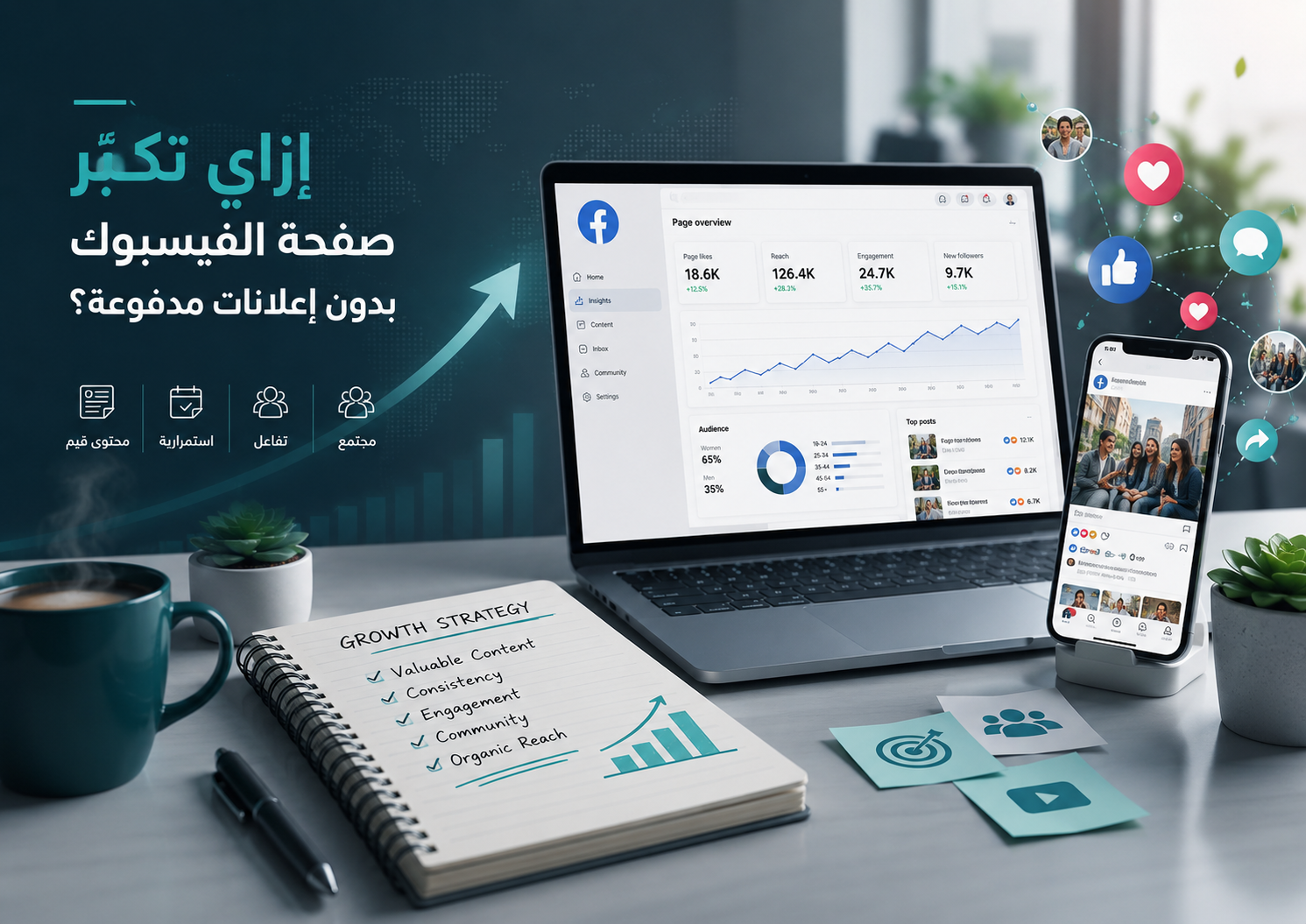
How to Grow Your Facebook Page Without Paid Ads
Growing a Facebook page without paid ads is possible, but it does not happen by luck. Organic growth needs valuable content, consistency, audience understanding, real engagement, and continuous performance analysis instead of random posting and waiting for results.
Many business owners believe that paid ads are the only way to grow a Facebook page. Ads are important, of course, but they are not the only path. A strong page needs an organic foundation: useful content, a clear brand identity, fast replies, trust, and a community that actually interacts with the brand.
The problem is that many pages publish only sales posts: “Buy now,” “Book today,” “Offer still available,” or “Message us now.” After a while, the page becomes a sales catalog instead of a place people want to follow. Real growth begins when the page gives value before asking people to buy.
First: Organic Growth Does Not Mean Growth Without Effort
Growing without paid ads does not mean the page will grow without time, cost, or work. It requires planning, content creation, replying to the audience, analyzing results, and improving your publishing style week after week.
Instead of paying directly for reach through ads, you invest time and effort in building trust and attracting a real audience. This type of growth may be slower, but it is stronger in the long term because it does not stop the moment your ad budget stops.
Ads can bring fast reach, but strong content builds an audience that trusts you even without continuous spending.
Before You Start: Fix the Page Basics
Do not start publishing heavily before making sure the page itself is ready to receive new visitors. When someone enters your page for the first time, they quickly decide: Is this page trustworthy? Do I understand what it offers? Should I follow it or leave?
Clear Profile Image
Use a clear and readable logo because the profile image appears small in comments, search results, and posts.
Professional Cover
The cover should quickly explain who you are, what you offer, and the main value you provide to customers.
Short and Strong Description
Avoid generic text. Explain the service, target audience, and best way to contact you.
Suitable CTA Button
Choose a clear call-to-action such as Send Message, Call, WhatsApp, or Visit Website based on the page goal.
Step 1: Define Your Audience Instead of Talking to Everyone
One of the biggest mistakes Facebook pages make is trying to speak to everyone. The result is content that does not touch anyone deeply. You need to define your main audience: business owners, mothers, students, doctors, restaurant owners, online stores, startups, or another clear group.
When you understand your audience, you understand what they fear, what questions they ask, what problems they face, and what type of content makes them stop, read, and engage.
| Question | Why It Matters |
|---|---|
| Who is the main audience? | So the content does not become too general and weak |
| What daily problem do they face? | To create content that reflects real needs |
| What prevents them from buying? | To create content that handles objections and builds trust |
| What language fits them? | The language of a doctor is different from a restaurant owner or a student |
| What content do they save or share? | Saves and shares are often more valuable than likes |
Step 2: Build Clear Content Pillars
Instead of publishing based on mood, create clear content pillars. Content pillars are repeated topic areas that your page keeps returning to. They help you produce content consistently and help the audience understand why they should follow you.
Examples of Content That Can Grow a Page Organically
Successful organic content is not just a nice-looking post. It is content that makes someone say: “This is about me,” “This is useful,” or “I need to send this to someone.”
Problem-Solving Content
Example: “3 mistakes that stop your website from getting clients” or “How to know if your ads are wasting money.”
Before and After Content
Show a clear transformation: before organizing the page and after, before improving service and after, or before using a system and after.
Frequently Asked Questions
Turn repeated customer questions into short, useful posts because silent followers may have the same questions.
Story-Based Content
Share a realistic situation or client scenario, then explain the lesson in a simple and useful way.
Shareable Content
Lists, tips, common mistakes, steps, or short statements that touch a clear problem can encourage sharing.
Expertise Content
Explain how you think, how you work, what standards you follow, and how you make professional decisions.
Step 3: Use Video and Reels Smartly
Video has become one of the most important content formats on Facebook, especially when it is fast, clear, and valuable from the first few seconds. The video does not need to be cinematic, but it should be easy to understand, short, and focused on one strong idea.
Use Reels to explain a small idea, answer a question, show a common mistake, make a comparison, or give a quick tip. The most important thing is to start with a clear hook that makes people continue watching.
Start With a Strong Line
The first few seconds matter. Start with a problem, question, or clear promise.
Deliver One Clear Value
Do not try to explain everything in one video. One clear idea is better than five scattered ideas.
End With a Simple Action
Ask for a comment, save, share, or specific question instead of always using a direct sales CTA.
Step 4: Post Consistently, Not Randomly
Consistency matters more than intense posting for a short period followed by silence. If you can publish 4 or 5 high-quality posts per week, that is better than posting 20 times in one week and disappearing for a month.
Build a system: days for educational content, days for trust-building content, days for behind-the-scenes stories, and days for offers or calls to action.
| Content Type | Suggested Weekly Frequency | Goal |
|---|---|---|
| Educational Content | 2 - 3 times | Build trust and attract interested people |
| Reels or Short Videos | 2 times | Increase reach and attention |
| Behind-the-Scenes or Story | 1 time | Show the human side of the brand |
| Trust Proof or Client Review | 1 time | Reduce hesitation before buying |
| Offer or Direct CTA | 1 time | Turn interest into messages, inquiries, or sales |
Step 5: Engagement Is Not Optional
A page that posts but never replies loses a lot of its power. Real interaction with comments and messages makes the page feel alive and encourages people to participate instead of just watching.
Reply to comments in a human way, ask questions, thank people, start conversations, and turn repeated questions into new posts.
Every comment is a chance to build trust, and every audience question can become a new content idea.
Step 6: Do Not Buy Likes or Followers
Buying likes or followers may look like a quick solution, but it usually hurts the page more than it helps. You get fake numbers from people who are not interested, which means real engagement becomes weaker.
A page with 5,000 interested followers is better than a page with 50,000 followers who do not engage, buy, or trust the brand. Do not let follower count fool you; audience quality matters more.
One real follower is more valuable than a thousand likes from people who do not understand your product.
Step 7: Use Groups and Communities Respectfully
Facebook groups can help you reach an interested audience, but only if you avoid spam. Do not enter groups just to post direct ads. Share useful answers, solve problems, contribute to discussions, and connect people to your page when it makes sense.
The goal is to appear as a helpful expert, not as a page chasing people with offers.
Choose Relevant Groups
Do not post everywhere. Choose communities directly connected to your target audience.
Answer Before Selling
Give real value in comments and discussions before adding any link or invitation.
Respect Group Rules
Ignoring group rules can damage your reputation and make people associate your brand with spam.
Turn Questions Into Content
Repeated questions inside groups are a great source of new post ideas.
Step 8: Use Your Existing Customers
Existing customers are one of the strongest sources of organic growth. If a customer is satisfied, ask for a review, comment, experience, or recommendation. Content based on real experience is stronger than any marketing statement you write about yourself.
Keep it simple and respectful: “If the experience was helpful, we would appreciate your feedback on the page.”
Customer Reviews
Share real reviews and experiences after customer approval and in a professional format.
Success Stories
Share the client’s problem before the service, the solution, and the result after implementation.
Referrals and Sharing
Encourage satisfied customers to share the page or post with someone who needs the service.
Step 9: Analyze Numbers Instead of Relying on Feelings
Do not depend on “I feel this post is good.” Open Insights and see what is really happening. Which posts got the highest reach? Which content got more comments? Which videos kept people watching? Which content increased followers?
Numbers do not mean your page becomes cold and robotic. They simply help you know what to repeat, what to stop, and what to improve.
| Metric | What It Means | How to Use It |
|---|---|---|
| Reach | How many people saw your content | Identify which content type reaches more people |
| Engagement | Comments, shares, likes, clicks | Understand which content makes people interact |
| Followers Growth | Follower increase over a period | Connect growth to the content you published |
| Video Retention | How long people continue watching | Improve the hook, length, and pace of videos |
| Messages | Number of messages or inquiries | Know whether content is bringing real opportunities |
A 30-Day Plan to Grow Your Page Without Ads
If you want to start practically, you do not need a complicated plan. Start with a 30-day test where you publish, measure, and learn from results.
Prepare and Analyze
Fix the page basics, review old content, define the audience, and write four main content pillars.
Publish and Test
Publish educational content, Reels, questions, stories, and customer proof. Test more than one hook style.
Analyze and Improve
Review the best posts, repeat what worked, and build the next month’s plan based on real numbers.
Mistakes That Stop Facebook Page Growth
Posting Only to Sell
If every post is direct selling, the audience will quickly get tired and ignore the page.
No Clear Identity
Different colors, changing tone, and random messages make the page look unprofessional.
Ignoring Comments
Not replying reduces trust and makes the page look disconnected from its audience.
Copying Competitors
Copying content does not build a unique page personality. Learn from the market, but create your own voice.
Depending Only on Trends
Trends may bring temporary reach, but they do not build trust unless they support the brand message.
Not Measuring Results
Without analysis, you will repeat the same mistakes because you do not know what worked and what failed.
Conclusion
Growing a Facebook page without paid ads is possible, but it requires a clear strategy. Start with an organized page, understand your audience, build content pillars, use video, post consistently, engage with the audience, use current customers, and analyze results regularly.
Do not look for fake shortcuts such as buying followers or copying competitors. Real organic growth happens when your page becomes a source of value and trust, not just a place for posting offers.
Ads can speed up growth, but strong content is what makes growth continue.
Turn Your Page From Random Posts Into a Real Growth Channel
MVPFI helps you build a content strategy, design a strong social media identity, write impactful posts, produce Reels, analyze performance, and turn your Facebook page into a channel that creates trust, inquiries, and sales opportunities.
Frequently Asked Questions
Can I grow a Facebook page without paid ads?
Yes, but it requires useful content, consistency, engagement, audience understanding, and continuous analysis. Organic growth is usually slower than ads, but it builds stronger trust.
How many times should I post per week?
A good starting point is 4 to 6 quality posts per week, including short videos or Reels, instead of posting randomly and then disappearing.
Are Reels important for Facebook page growth?
Yes. Short video can help increase reach and attention, especially when it starts with a strong hook and gives clear value quickly.
Does buying followers help?
No. Buying followers only increases the number visually, but it hurts audience quality and engagement. It can make the page look large but weak.
What is the best type of content for organic growth?
The best content solves a clear audience problem, answers a real question, proves your expertise, or provides value worth saving and sharing.
Should I use Facebook groups?
Groups can help if used respectfully and without spam. Give helpful answers and real value before directly inviting people to your page.
How do I know if my page is growing correctly?
Track reach, engagement, follower growth, messages, saves, shares, and content performance, not only the number of likes.
How can MVPFI help grow a Facebook page?
MVPFI helps with content strategy, post design, professional copywriting, short video production, performance analysis, and improving the page to increase trust and engagement.

Add New Comment