 English
 العربية

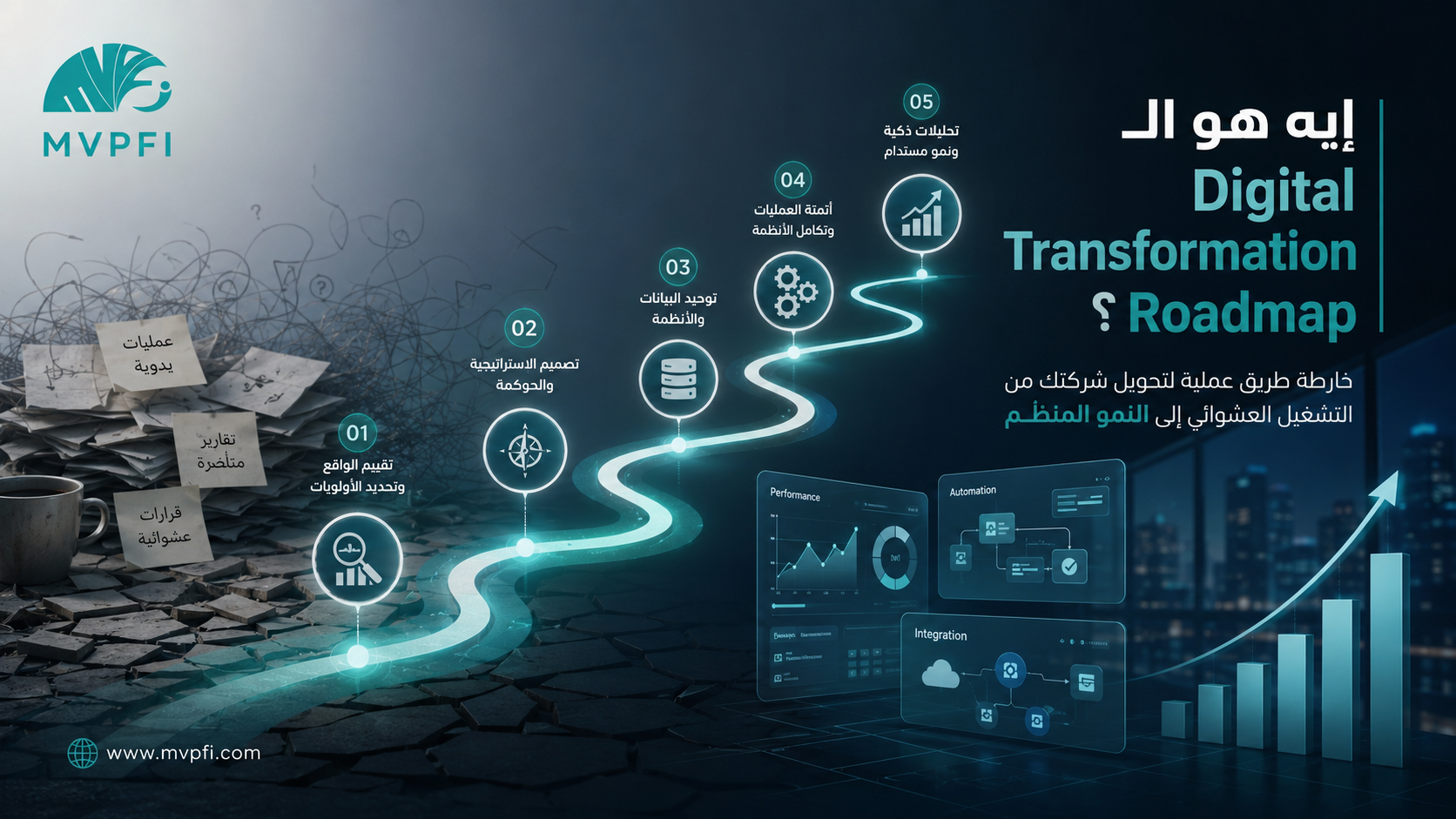
What Is a Digital Transformation Roadmap?
A Digital Transformation Roadmap turns the broad idea of “we need to digitalize the business” into a real execution plan: where should we start, what should we fix first, which systems do we need, who is responsible, how will success be measured, and how do we make sure digital transformation serves the business instead of becoming just another unused software system?
Many companies start digital transformation from the wrong direction. They buy software, install a system, build a website, or request a full ERP solution — then later discover that the same operational problems still exist. The reason is often simple: the company started with the tool before building the roadmap.
Successful digital transformation does not start with the question: “Which software should we buy?” It starts with a more important question: “How do we need to change the way the business works, and which priorities will actually improve operations, sales, customer experience, and management visibility?”
What Does Digital Transformation Roadmap Mean?
A Digital Transformation Roadmap is a structured plan that defines how a company moves from manual, scattered, or disconnected operations to a more organized digital way of working, powered by data, systems, automation, and integration between departments.
The roadmap does not focus on technology alone. It connects technology to real business goals: reducing waste, speeding up decisions, improving customer experience, reducing errors, increasing productivity, and giving management clearer visibility into numbers and performance.
A digital transformation roadmap is the difference between a company that buys a new system and a company that builds a smarter way of working.
Why Does Your Business Need a Roadmap Before Execution?
Without a roadmap, digital transformation often becomes a collection of disconnected decisions: a sales system here, an inventory spreadsheet there, a separate website, a CRM that the team does not use, and reports that do not connect to accounting. The result is more tools, but not necessarily less chaos.
A roadmap helps you define priorities, avoid unnecessary costs, apply change gradually, and measure whether each step has created real business value or not.
Digital Transformation Strategy vs Roadmap
The strategy defines the direction: why are we transforming digitally, what are our goals, and what should the company look like after transformation? The roadmap is the practical execution plan that explains what will happen first, when, with which tools, by which team, and with which success metrics.
| Point | Digital Transformation Strategy | Digital Transformation Roadmap |
|---|---|---|
| Main Purpose | Defines the vision and overall direction | Turns the vision into executable steps |
| Main Question | Why do we need digital transformation? | How will we execute digital transformation? |
| Outputs | Goals, priorities, and guiding principles | Phases, timelines, responsibilities, systems, and KPIs |
| Measurement | Measures progress toward major business goals | Measures the outcome of each phase and project |
Stage 1: Assess the Current Situation
The first step in any roadmap is understanding reality as it is — not as management wishes it to be. You need to know where data gets lost, where mistakes repeat, where decisions are delayed, and which department creates the most waste in time, money, or customer experience.
Process Analysis
Review the sales cycle, inventory, accounting, customer service, approvals, reporting, and delivery workflows.
Data Analysis
Identify where data lives: spreadsheets, WhatsApp, notebooks, separate systems, or employee memory — and whether it is accurate.
Current Tools Review
What systems are currently used? Do they work together? Does the team actually use them? Do they produce useful results?
Pain Point Analysis
Define the most damaging problems: slow reports, lost orders, inventory errors, weak customer follow-up, or delayed collections.
You cannot build a correct roadmap if the current business reality is not clear and honest.
Stage 2: Define the Vision and Goals
After understanding the current situation, you need to define where you want to go. Is the goal to reduce errors, speed up the sales cycle, connect branches, improve customer follow-up, organize inventory, produce live financial reports, automate approvals, or all of that gradually?
The goal should be measurable. Instead of saying “we want to improve the company,” say: “we want to reduce report preparation time from two days to two hours,” or “reduce lost leads by 50%,” or “connect sales with inventory and accounting.”
| General Goal | Measurable Goal |
|---|---|
| Improve sales | Track every lead from first contact to closing inside a CRM |
| Organize inventory | Reduce stock variance and connect orders to item movement |
| Improve management visibility | Generate daily reports and management dashboards |
| Improve customer service | Record every complaint as a ticket and measure response and resolution time |
Stage 3: Prioritize What Comes First
One of the biggest mistakes is trying to execute everything at once. Successful digital transformation starts with what matters most. Prioritize based on impact, ease of implementation, cost, and risk.
For example, if your biggest issue is losing potential customers, start with CRM before advanced accounting automation. If your biggest issue is inventory accuracy, start by connecting inventory with sales before building a complex BI dashboard.
Impact
Start with the problem causing the biggest loss, delay, or operational waste.
Ease of Execution
Do not always start with the hardest task. Sometimes a small fast win builds team confidence.
Risk
Review the impact of change on operations, employees, customers, and data before execution.
Stage 4: Design Processes Before Choosing the System
Do not choose the system before understanding the processes. You need to define how an order moves, who approves what, when the invoice is issued, how inventory is updated, how a complaint is escalated, and how reports are generated.
A good system cannot fix a chaotic process by itself. If the process is unclear, the system will only move the same chaos into a better-looking screen.
Before choosing the software, map the workflow. A successful system starts with a clear process.
Stage 5: Choose the Right Tools and Systems
After defining processes and priorities, it is time to choose tools. You may need a CRM, ERP, help desk system, e-commerce platform, analytics dashboard, API integrations, or cloud solutions. The important thing is to choose based on business needs, not based on big names or features you do not actually need.
Customer and Sales Management
Useful for tracking leads, proposals, follow-ups, sales opportunities, and deal stages.
Internal Operations Integration
Useful for connecting sales, inventory, accounting, purchasing, suppliers, and reporting.
Support and Customer Service
Useful for recording complaints and requests, measuring response time, and analyzing recurring issues.
Analytics Dashboards
Useful for showing management KPIs and connecting data from multiple sources.
Stage 6: Unify Data and Integrate Systems
Digital transformation cannot succeed if data remains scattered. There should be a clear source of truth: one customer code, one product code, invoices connected to orders, payments connected to accounts, and all departments working from aligned data.
System integration is essential. For example, an order from the website should appear in the sales system, deduct stock, show in accounting, and turn into a support ticket if an issue happens.
| Problem | Without Integration | With Good Integration |
|---|---|---|
| Website Orders | Manually transferred, with higher risk of errors | Automatically enters sales and inventory |
| Customer Data | Repeated across multiple files and systems | Unified record for every customer |
| Reports | Manually collected from different sources | Live or near-live dashboard |
| Invoices and Payments | Manual matching and possible mistakes | Direct link between invoice, payment, and accounting |
Stage 7: Manage Change and Train the Team
The biggest resistance in digital transformation usually does not come from technology. It comes from people. An employee who is used to spreadsheets or paper may feel that the new system is a burden, a monitoring tool, or a threat. That is why training and communication are critical.
Explain to the team why the change is happening, how it will make work easier, what is expected from them, and what will change in responsibilities. Do not introduce a new system suddenly without preparation.
Explain the Purpose
The team needs to know why the change is happening, not only what they must do.
Practical Training
Training should be based on real scenarios from the team’s daily work.
Post-Launch Support
The first weeks after launch need follow-up, answering questions, and correcting usage habits.
Stage 8: Execute in Phases
Do not try to transform the entire company at once. A roadmap should be executed in phases: a first fast phase that proves value, then gradual expansion. This reduces risk and gives the team time to adapt.
Quick Wins
Start with fast improvements that show clear value, such as organizing leads or speeding up reports.
Pilot Phase
Apply the system to one department, branch, or process before rolling it out to everyone.
Scale
After the pilot succeeds, expand gradually to more departments, branches, or workflows.
Optimize
Improve based on real usage, reports, team feedback, and performance results.
Stage 9: Define KPIs and Measure Success
A roadmap without KPIs becomes just a task list. You need clear indicators that show whether digital transformation created business value or not.
| KPI | What It Measures |
|---|---|
| Process Completion Time | Did invoices, reports, orders, or approvals become faster? |
| Error Rate | Did data entry, invoicing, inventory, or follow-up errors decrease? |
| System Adoption | Is the team actually using the system, or returning to spreadsheets and WhatsApp? |
| Report Quality | Can management see more accurate numbers in less time? |
| Customer Satisfaction | Are replies faster, and are orders and complaints tracked clearly? |
| Operational Return | Did waste decrease, productivity improve, or sales and collections become better? |
A Simple 6-Month Digital Transformation Roadmap Example
Every roadmap differs depending on the company, but this is a simple example for a business that wants to organize sales, inventory, and accounting gradually.
Analysis and Planning
Analyze processes, identify problems, prioritize needs, and define success indicators.
CRM and Sales
Organize customers, sales stages, proposals, follow-ups, and lead sources.
Inventory and Invoicing
Connect orders with inventory, issue invoices, and record item movement.
Accounting and Collections
Connect invoices with payments, track customer balances, and monitor collections.
Dashboard and Optimization
Build management reports, review system usage, and improve workflows based on data.
Expansion and Integration
Add support, HR, automation, integrations, or new branches based on priority.
Common Mistakes When Building a Digital Transformation Roadmap
Having a roadmap does not automatically mean success. Some mistakes repeat often and lead to poor implementation or low system adoption.
Starting With Technology Before the Problem
Buying a system before analyzing operations may lead you to pay for features that do not solve the real problem.
Trying to Execute Everything at Once
Large sudden change can confuse the team and increase the risk of implementation failure.
Ignoring Old Data
Moving messy data into a new system means you transferred the problem instead of solving it.
Not Defining Responsibilities
It must be clear who enters data, who reviews it, and who owns the decision to edit or approve it.
Lack of Training
The system will not succeed if users do not understand how to use it and why they are using it.
No Measurement After Execution
Without KPIs, you will not know whether digital transformation created value or only changed the appearance.
Who Should Participate in Building the Roadmap?
Digital transformation is not the responsibility of the IT department alone. Management, operations, sales, accounting, customer service, and the employees who use systems every day should all participate.
Each department sees a different part of the problem, and the success of the roadmap depends on understanding the full reality — not only the technical perspective.
| Stakeholder | Role in the Roadmap |
|---|---|
| Management | Defines vision, priorities, budget, and major decisions |
| Operations | Explains real workflows and daily operational problems |
| Sales | Explains the customer journey, follow-ups, proposals, and conversions |
| Accounting | Defines invoicing, collections, journal entries, and financial reporting needs |
| Support and Customer Service | Explains repeated complaints, ticketing needs, and follow-up requirements |
| Technical Team | Selects the right infrastructure, integrations, security, and scalability approach |
Conclusion
A Digital Transformation Roadmap is the plan that prevents digital transformation from becoming a random decision or a software purchase without results. It connects technology with goals, processes with systems, and data with decisions.
Start by assessing the current situation, defining your goals, prioritizing, designing processes, choosing the right systems, training the team, executing in phases, and measuring results continuously.
Real digital transformation does not happen in one day, but it starts with a clear roadmap that prevents you from repeating the same chaos with more expensive tools.
Start With a Clear Plan Before Investing in Systems That May Not Serve Your Real Goal
MVPFI helps you analyze operations, identify waste points, build a Digital Transformation Roadmap, choose the right CRM and ERP systems, design integrations, and prepare performance indicators that help your company transform digitally in a practical and organized way.
Frequently Asked Questions
What does Digital Transformation Roadmap mean?
It is a roadmap that defines the stages of digital transformation inside a company, from current-state assessment and prioritization to system selection, execution, training, and measurement.
Is a digital transformation roadmap important for small businesses?
Yes. Small businesses need a clear roadmap so they do not waste budget on tools that do not solve the core problem or systems the team does not use.
What is the difference between a roadmap and buying an ERP system?
An ERP is an execution tool. A roadmap defines whether you need ERP, when to implement it, and how to connect it to processes, data, and business goals.
What is the first step in building a digital transformation roadmap?
The first step is assessing the current situation: processes, data, tools, pain points, and sources of waste inside the business.
Should digital transformation be executed all at once?
No. It is usually better to execute in phases to reduce risk, train the team, measure results, and then scale gradually.
What are the most important digital transformation success KPIs?
Important KPIs include reduced process time, fewer errors, system adoption, clearer reports, better customer experience, and stronger data-based decision-making.
Who is responsible for the digital transformation roadmap?
It is a shared responsibility between management, the technical team, and department leaders because digital transformation affects how the business works, not technology alone.
How can MVPFI help with a Digital Transformation Roadmap?
MVPFI helps assess the current situation, prioritize needs, design processes, choose systems, build CRM and ERP solutions, implement integrations, and create clear performance dashboards.

Add New Comment