 English
 العربية

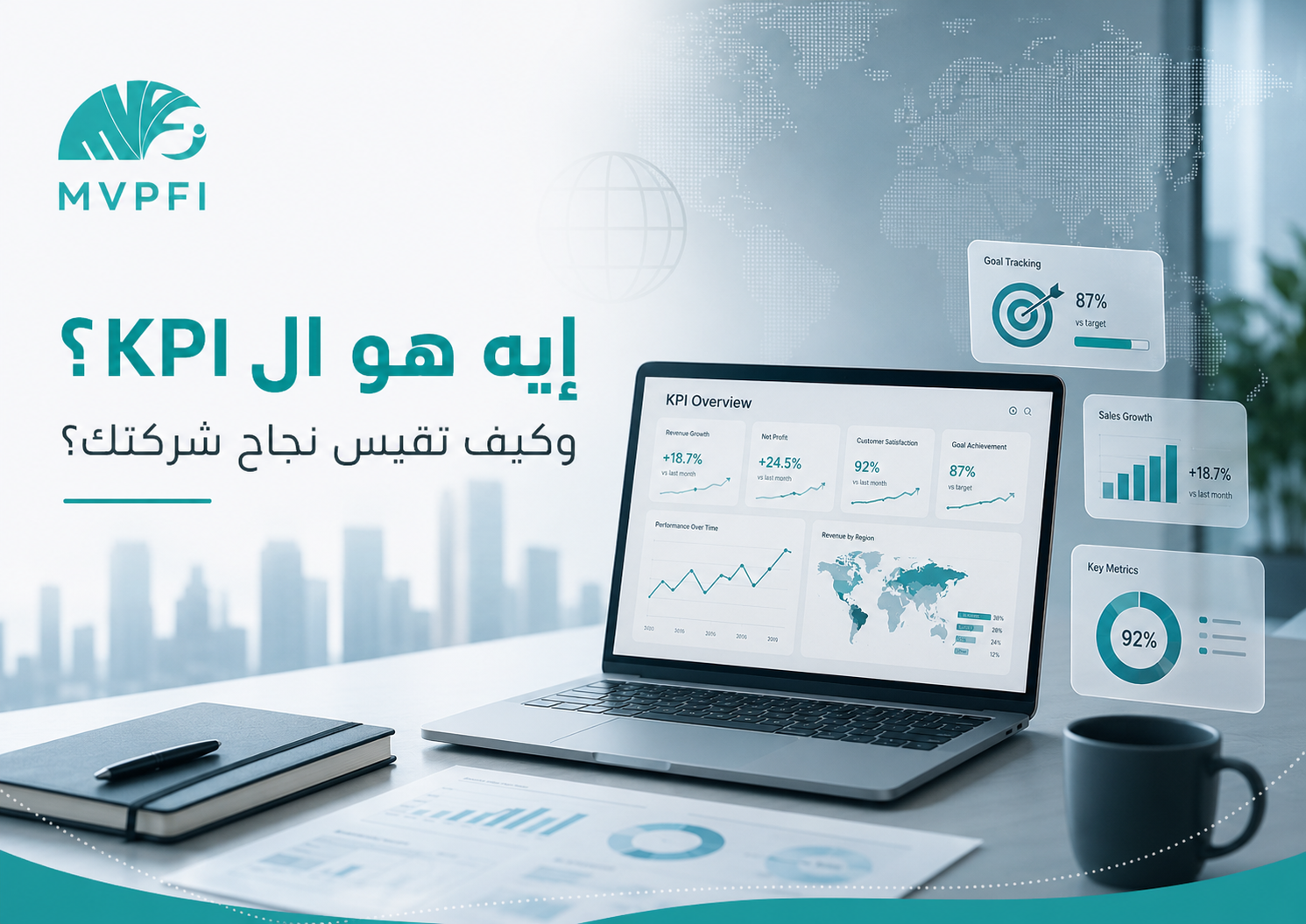
What Is a KPI and How Do You Measure Your Company’s Success?
A KPI is not just a number you place inside a report. It is a clear performance indicator that helps you understand whether your company is moving in the right direction or not. Simply put: if the goal is the destination, the KPI is the gauge that tells you how close you are.
Many companies work hard every day: selling, spending, replying to customers, delivering orders, running marketing campaigns, hiring people, and managing operations. But at the end of the month, the real question becomes: “Are we actually succeeding, or are we just busy?”
This is where KPI comes in. KPI stands for Key Performance Indicator. It is a number or measurable indicator connected to an important business goal. It helps management understand real performance instead of depending on feelings, assumptions, or general statements.
What Does KPI Mean?
A KPI is a measurable indicator that shows how well a company, team, department, or employee is progressing toward a specific goal. Instead of saying “we want to improve sales,” you use KPIs such as monthly sales growth, number of new customers, average order value, or deal closing rate.
The important point is that a KPI must be connected to a real goal, have a clear number, be measured within a defined time period, and have a person or team responsible for it. Otherwise, it becomes a nice-looking number in a report that does not support decision-making.
A good KPI does not only tell you what happened — it helps you understand what to do next.
The Difference Between a Goal and a KPI
A goal is the result you want to achieve. A KPI is the indicator that measures whether you are moving closer to that result or not.
| Element | Example | Meaning |
|---|---|---|
| Goal | Increase sales | A general result the company wants to achieve |
| KPI | Increase monthly sales by 20% | A measurable indicator that tracks progress toward the goal |
| Goal | Improve customer service | A general direction for improving customer experience |
| KPI | Reduce average response time to under 10 minutes | A clear measurement that can be tracked and improved |
Why Are KPIs Important for Businesses?
Without clear performance indicators, a company may be doing a lot of work without knowing whether that work is creating real results. KPIs move management from impressions and assumptions to numbers and decisions.
Types of KPIs
Not all KPIs are the same. Some indicators measure final results, while others measure the activities that lead to those results. A strong business should use both types.
Lagging KPIs
These measure results after they happen, such as revenue, net profit, number of sales, or customer retention rate.
Leading KPIs
These predict future results, such as number of calls, proposals sent, website visits, response rate, or qualified leads.
Strategic KPIs
These are connected to high-level management goals, such as revenue growth, market share, profitability, or expansion.
Operational KPIs
These are connected to daily operations, such as order processing time, error rate, delivery speed, or team productivity.
A Simple Example: Leading vs Lagging KPIs
If your goal is to increase sales, the lagging KPI is the final sales number at the end of the month. But that appears after the period is over. Leading KPIs help you predict whether sales are likely to increase before the month ends.
Indicators Before the Result
Number of leads, calls, proposals, response rate, and meetings booked.
Indicators During Execution
Follow-up rate, lead quality, response speed, and movement between sales stages.
Indicators After the Result
Total sales, net profit, new customers, and deal closing rate.
How to Choose the Right KPI
Choosing the wrong KPI can be more dangerous than not measuring at all. It may push the team to improve a number that looks good, while the real business problem remains elsewhere.
| Question | Why It Matters |
|---|---|
| What is the main goal? | So the KPI is connected to a real business outcome |
| Is the indicator measurable? | A KPI without a clear number cannot be tracked properly |
| Can the team influence it? | The team should be able to improve it through clear actions |
| Does it have a time period? | So performance can be judged daily, weekly, monthly, or quarterly |
| Who owns it? | A KPI without an owner becomes a number with no management |
Characteristics of a Good KPI
A good KPI should be clear, practical, connected to a goal, and comparable against a target or previous period.
Clear
Everyone in the team should understand what the indicator means and how it is calculated.
Measurable
It should have a clear number and a known data source such as CRM, ERP, Google Analytics, or accounting software.
Goal-Linked
It should not be chosen only because the number is available. It must help measure an important company goal.
Actionable
The team should know what actions can be taken to improve this indicator.
Sales KPI Examples
Sales KPIs should not be limited to total revenue only. The final sales number does not always explain where the real issue is: lead volume, lead quality, follow-up, pricing, or closing rate.
| KPI | What It Measures |
|---|---|
| Sales Revenue | Total revenue generated from sales during a specific period |
| Conversion Rate | Percentage of leads that become actual customers |
| Average Deal Size | Average value of each deal or order |
| Sales Cycle Length | Average time from first contact to closing the deal |
| Lead Response Time | How quickly the sales team responds to potential customers |
| Close Rate | Percentage of opportunities or proposals that result in sales |
Marketing KPI Examples
Marketing should not be measured by likes alone. Strong marketing KPIs connect activity to real results: traffic, leads, acquisition cost, sales, or return on investment.
Cost per Lead
The cost of generating one potential customer from a campaign or marketing channel.
Marketing ROI
The real return from marketing compared to the full cost of campaigns, content, tools, and management.
Website Conversion Rate
The percentage of website visitors who complete an important action such as submitting a form, buying, or booking.
Qualified Leads
The number of potential customers who are actually suitable, not just the number of clicks or messages.
Operations and Productivity KPI Examples
Operations is where time, waste, and repeated errors often appear. Operational KPIs help you know whether the company is working efficiently or consuming too much effort in unnecessary steps.
| KPI | What It Measures |
|---|---|
| Cycle Time | The time needed to complete a process from start to finish |
| Error Rate | The percentage of errors in execution, data entry, or delivery |
| On-Time Delivery | The percentage of orders or projects delivered on time |
| Task Completion Rate | The percentage of completed tasks compared to planned tasks |
| Cost per Process | The cost of completing a specific process such as an order, invoice, or support ticket |
Customer Service KPI Examples
Customer service should not be measured only by the number of replies. You should measure speed, quality, customer satisfaction, and whether the same problems keep repeating.
Average Response Time
The average time it takes the team to respond after the customer first contacts the company.
First Contact Resolution
The percentage of issues resolved during the first contact without escalation or long follow-up.
Customer Satisfaction
How satisfied customers are with the service through ratings, surveys, or reviews.
Ticket Resolution Time
The average time from opening a support ticket to resolving and closing it.
Financial KPI Examples
Financial KPIs help management understand whether the company is growing in a healthy way, or whether sales are increasing while profit is weak and expenses are consuming growth.
| KPI | What It Measures |
|---|---|
| Gross Profit Margin | Gross profit percentage after deducting the cost of products or services |
| Net Profit Margin | Net profit percentage after all expenses |
| Cash Flow | Money coming in and out of the business and overall liquidity |
| Accounts Receivable Days | Average number of days needed to collect customer payments |
| Customer Acquisition Cost | The cost of acquiring a new customer through marketing and sales |
Steps to Build KPIs for Your Company
Building KPIs does not start by choosing many numbers. It starts by understanding company goals, then turning each goal into a few clear and useful indicators.
Define Company Goals
Is the goal to increase sales, reduce cost, improve customer service, or increase productivity?
Choose a Few Indicators
You do not need 50 KPIs. Choose the most important 5 to 10 indicators for each management level or department.
Define Data Sources
Will the data come from CRM, ERP, Google Analytics, ticketing software, spreadsheets, or accounting systems?
Review and Improve
Review KPIs regularly and adjust them if they no longer serve company goals or management decisions.
KPI vs Metric: What Is the Difference?
Every KPI is a metric, but not every metric is a KPI. A metric is any number you measure. A KPI is a very important number connected to a key goal and decision.
| Metric | KPI |
|---|---|
| Number of website visitors | Percentage of visitors who turn into leads or sales |
| Number of likes on a post | Number of qualified inquiries generated from content |
| Number of calls | Percentage of calls that turn into meetings or sales |
| Number of support tickets | Average ticket resolution time and customer satisfaction after resolution |
Common Mistakes When Using KPIs
KPIs can be very useful, but they can also harm decision-making if they are chosen or used incorrectly.
Measuring Too Many Numbers
Too many KPIs distract the team. It is better to track fewer but more meaningful indicators.
Focusing on Vanity Metrics
Likes and traffic are not enough unless they are connected to leads, sales, or real business value.
No Clear Owner
Every KPI should have a clear owner who monitors performance and suggests improvements.
Using Inaccurate Data
If the data source is not organized, decisions based on the KPI can become misleading.
Measuring Only Final Results
Do not only measure outcomes. Use leading indicators that help you act before it is too late.
Not Reviewing KPIs
What mattered last year may not be the most important today. KPIs should match the company’s current stage.
How to Measure Company Success Using KPIs
Company success should not be measured by one KPI only. You need a balanced set of indicators covering finance, customers, operations, marketing, and sales.
For example, a company with high sales but poor customer retention may not be truly successful. A company with strong social media engagement but no qualified leads may also be measuring the wrong thing.
Real business success appears when growth, profitability, customer satisfaction, operational efficiency, and team stability work together.
KPI Dashboard
One of the best ways to track KPIs is through a clear dashboard that displays the most important indicators in one place. The goal is not to fill the screen with charts, but to help management understand performance quickly.
| Dashboard Area | Example KPIs |
|---|---|
| Sales | Revenue, number of deals, close rate, average order value |
| Marketing | Cost per Lead, conversion rate, ROI, best-performing channels |
| Customers | Satisfaction, retention, complaints, average response time |
| Operations | Process time, errors, on-time delivery, team productivity |
| Finance | Net profit, cash flow, expenses, collections |
A 30-Day Plan to Build KPIs in Your Company
If your company does not use KPIs clearly yet, start with a simple 30-day plan instead of building a complicated system from the beginning.
Define Goals
Meet with management and define the top 3 to 5 goals for the company or department.
Select Indicators
Choose 2 to 3 KPIs for each goal, with a clear definition, calculation method, and data source.
Collect Data
Connect data from systems or spreadsheets and make sure the numbers are accurate and reviewable.
Present and Review
Build an initial dashboard, review the results, and define improvement actions based on the numbers.
Conclusion
A KPI is an important tool for measuring company success, but it does not work alone. It must be connected to a clear goal, measurable, supported by a reliable data source, and owned by someone who follows it.
Do not measure everything. Measure what helps you make decisions. Do not focus only on vanity metrics. Focus on indicators that reflect real growth, profitability, customer satisfaction, and operational efficiency.
A company that clearly understands its performance indicators can move faster, fix problems earlier, and grow in a more organized and safer way.
Turn Scattered Business Numbers Into Clear Performance Indicators
MVPFI helps you define the right KPIs for your company, build dashboards, connect data from CRM, ERP, and marketing systems, and prepare reports that help management make faster and more accurate decisions.
Frequently Asked Questions
What does KPI mean?
KPI stands for Key Performance Indicator. It is a measurable number that tracks progress toward a specific goal.
What is the difference between a goal and a KPI?
A goal is the result you want to reach. A KPI is the indicator that measures progress toward that goal.
How many KPIs should a company track?
There is no fixed number, but it is better to choose a few meaningful KPIs instead of tracking too many numbers that do not support decisions.
Are likes considered a KPI?
Likes can be a metric, but they only become an important KPI if they are connected to a clear goal such as awareness, lead generation, or meaningful engagement.
What are the most important sales KPIs?
Important sales KPIs include total revenue, conversion rate, average deal size, sales cycle length, close rate, and lead response time.
What are the most important customer service KPIs?
Important customer service KPIs include average response time, ticket resolution time, customer satisfaction, first contact resolution, and repeated complaints.
Can a dashboard help track KPIs?
Yes. A dashboard is one of the best ways to collect important KPIs in one place and help management see performance quickly.
How can MVPFI help with KPI measurement?
MVPFI helps define the right performance indicators, connect data sources, build dashboards, and turn business numbers into clear decisions.

Add New Comment