 English
 العربية

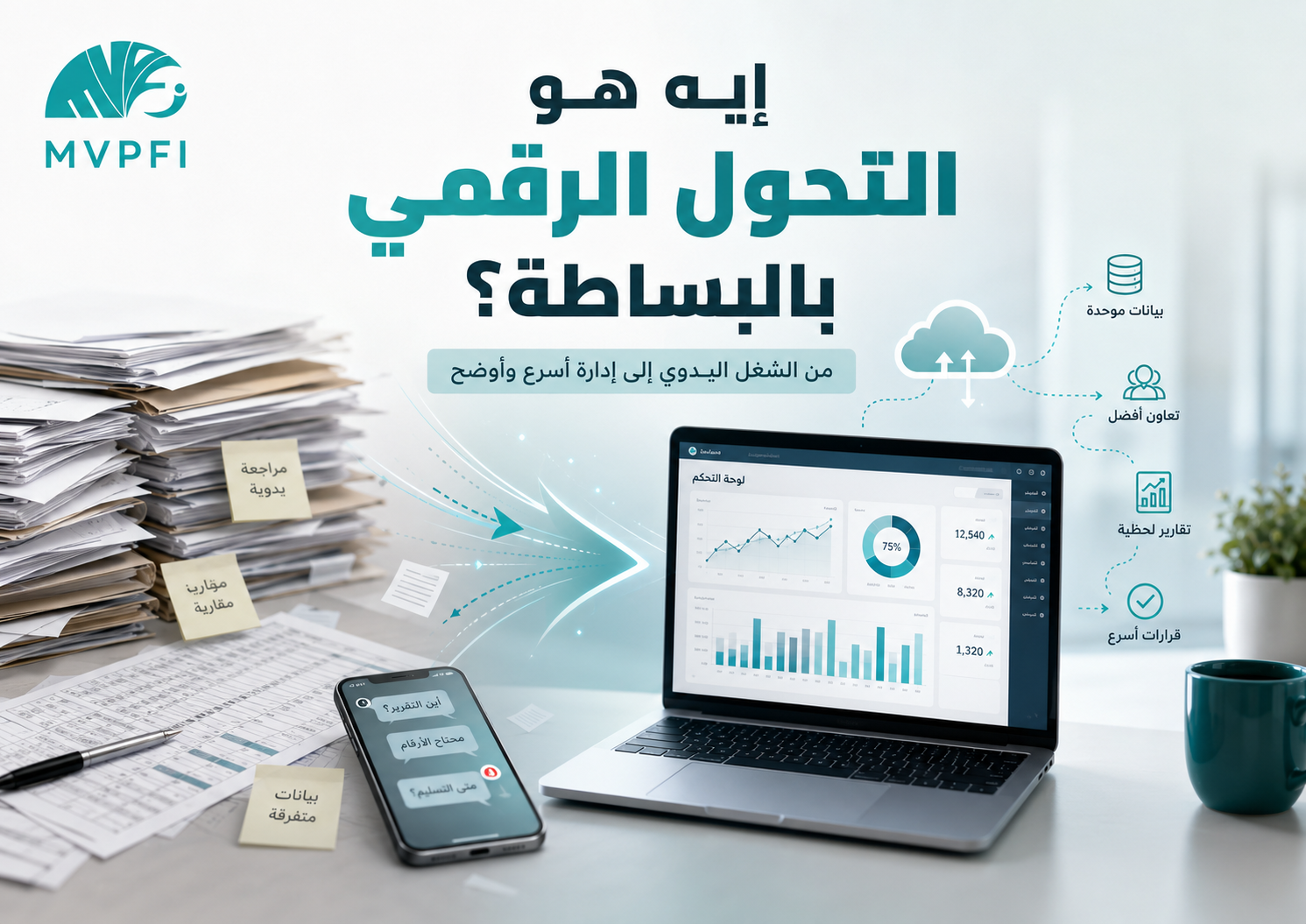
What Is Digital Transformation in Simple Terms?
Digital transformation does not simply mean buying software, nor does it mean turning paper documents into PDF files. Real digital transformation means changing how your business operates by using technology, data, and systems to make work faster, clearer, less error-prone, and easier to measure and manage.
Many business owners hear the term “digital transformation” and feel that it is too big, complicated, or only relevant to large enterprises. In reality, any business — even a small one — can start digital transformation in a simple and practical way: organizing customers, tracking sales, managing inventory, issuing invoices, following up with employees, or understanding profits and costs more accurately.
The main idea is not to use technology just for appearances. The goal is to use technology to solve real operational problems: lost data, slow decisions, repeated mistakes, dependency on one employee, unclear numbers, scattered files, or a confusing customer journey.
What Does Digital Transformation Mean?
Simply put, digital transformation is the use of digital tools and systems to reorganize how a business works. Instead of every department working in separate files, notebooks, or scattered WhatsApp messages, data and processes are unified inside a clear system that can be tracked, measured, and improved.
This means sales are connected to customers, customers are connected to invoices, invoices are connected to accounting, inventory is connected to orders, and management can see the full picture through clear reports instead of relying on assumptions.
Digital transformation is not moving work from paper to screens — it is moving the business from chaos to smart management.
Digital Transformation Is Not Just Software
One of the biggest mistakes is assuming that buying an ERP, CRM, or website means the business has become digitally transformed. Software is only a tool. Digital transformation is a way of thinking and operating.
If you buy the most powerful system in the world but employees do not use it, data is entered incorrectly, processes are unclear, and reports are never reviewed, then no real transformation has happened.
| Common Misconception | The Reality |
|---|---|
| Digital transformation means buying software | Software is a tool, but the real value is in organizing work and data |
| Digital transformation means replacing employees | Its goal is to help employees work faster and with fewer mistakes |
| Digital transformation is only for large companies | Small businesses may need it even more because chaos affects them faster |
| Digital transformation happens once | It is a continuous journey of improvement, measurement, and development |
A Simple Example
Imagine a company that sells products. Orders come from Facebook, WhatsApp, and the website. An employee records orders in a spreadsheet, inventory is tracked in another file, accounting is managed in a notebook, and the manager asks every day: “How much did we sell? What is left in stock? Who has not paid yet?”
In this situation, the company is operating, but management is difficult. Mistakes are likely, data is scattered, and decisions are delayed.
Scattered Manual Work
Orders on WhatsApp, data in spreadsheets, stock not updated, and reports that take too much time.
Unified System
The order is entered once, then recorded as a customer, invoice, inventory movement, and payment record.
Faster Decisions
Management can see sales, stock, collections, costs, and profits through clear reports.
What Are the Benefits of Digital Transformation?
The benefits of digital transformation do not appear only in the system interface. They appear in how the business is managed. When data is organized and processes are clear, decisions become faster and more accurate.
Main Areas of Digital Transformation Inside a Business
Digital transformation can start from any area that affects operations. You do not have to transform everything at once. It is usually better to start with the area that causes the most waste, delay, or repeated mistakes.
Customer Management CRM
Organizing customer data, sales stages, follow-ups, calls, proposals, and opportunities instead of relying on memory or scattered messages.
Sales and Invoicing
Issuing invoices, tracking payments, identifying best-selling products, and analyzing sales performance by period, employee, or branch.
Inventory Management
Knowing real stock levels, low-stock alerts, item movements, returns, and product cost without guesswork.
Accounting and Reports
Tracking revenue, expenses, cash accounts, customer debts, suppliers, profit and loss, and financial reports.
Human Resources
Managing attendance, leaves, salaries, tasks, performance, and employee permissions inside the system.
Customer Service and Support
Recording complaints and requests as tickets, tracking response time, identifying repeated issues, and measuring customer satisfaction.
The Difference Between Automation and Digital Transformation
Automation means making a specific task happen automatically instead of manually. For example, sending a confirmation message after a customer places an order. Digital transformation is broader because it connects processes, data, and decisions across the business.
| Point | Automation | Digital Transformation |
|---|---|---|
| Scope | A specific task or step | A full way of operating inside the business |
| Example | Sending an automatic message after customer registration | Connecting customers with sales, invoices, support, and reports |
| Goal | Save time in a repeated task | Improve management, decisions, and operations as a whole |
| Value | Reduces repetitive effort | Builds a clearer, scalable, and more measurable business system |
How Do You Know Your Business Needs Digital Transformation?
You do not have to wait until problems become too large. There are clear signs that your business needs better digital organization.
Data Is Scattered
Part of it is in spreadsheets, part in WhatsApp, part in notebooks, and part in employees’ memory.
Reports Take Too Long
You need hours or days to know sales, inventory, profits, expenses, or collections.
Mistakes Keep Repeating
Wrong invoices, lost orders, inaccurate stock, or irregular customer follow-ups.
Dependency on One Person
If one employee is absent, a major part of the business stops because they are the only one who knows the details.
Customers Wait Too Long
Replying to customers, processing orders, or solving complaints takes too long because the process is unclear.
Management Cannot See the Full Picture
Decisions depend on feelings or verbal updates instead of real numbers and clear reports.
Simple Steps to Start Digital Transformation
The beginning does not need to be huge or complicated. Successful businesses start by identifying the most important problem, then building a gradual solution that can scale over time.
Analyze the Current Situation
Identify where data gets lost, where mistakes repeat, where delays happen, and what consumes the team’s time.
Start With the Priority
Do not start with all departments at once. Start with sales, inventory, accounting, or support based on the biggest pain point.
Train the Team and Measure Results
A system will not succeed without training, follow-up, and measurement: did time decrease, did errors decrease, and did reports become clearer?
What Tools Support Digital Transformation?
Tools differ depending on the business type, but most companies need systems that organize data and processes instead of leaving everything manual or disconnected.
| Tool | Role | When You Need It |
|---|---|---|
| CRM | Manages customers, opportunities, and follow-ups | When you have leads, sales, or a team following up with customers |
| ERP | Connects departments such as sales, inventory, and accounting | When daily operations need full organization |
| Help Desk | Manages customer support and complaints as tickets | When you have repeated support requests or customer complaints |
| BI Dashboard | Displays and analyzes performance indicators | When you need live reports instead of manual collection |
| Cloud Storage | Stores files securely and keeps them accessible | When files are scattered across employees and devices |
Common Digital Transformation Mistakes
Digital transformation can fail when it is treated as buying software only, or when management decides to apply a system without preparing the team.
Choosing a System Before Understanding the Problem
Do not start with the tool. Start with the problem, process, and goal, then choose the right system.
Applying Everything at Once
Sudden transformation can confuse the team. A gradual, clear, measurable approach is usually better.
Ignoring Employee Training
A strong system fails if the team does not understand how to use it and why they are using it.
Not Cleaning Old Data
Moving old messy data into a new system does not create a successful system. It only moves the chaos.
Not Defining Responsibilities
Every employee should know what to enter, what to review, and who is responsible for data accuracy.
Measuring Appearance Instead of Results
Do not ask only whether the system exists. Ask whether time decreased, errors decreased, and decisions improved.
How to Measure Digital Transformation Success
Digital transformation success is not measured by the number of screens or features. It is measured by its impact on operations, decisions, and customers.
| Metric | What It Measures |
|---|---|
| Process Completion Time | Did orders, invoices, or reports become faster? |
| Error Rate | Did data entry, invoicing, or inventory mistakes decrease? |
| Report Clarity | Can management see numbers without long delays? |
| Customer Satisfaction | Are replies faster and are orders or complaints tracked more clearly? |
| Less Dependency on Individuals | Is knowledge now inside the system instead of only inside one person’s memory? |
Is Digital Transformation Expensive?
The cost depends on the company size and the type of solution. But the better question is not “How much will the system cost?” The better question is: “How much is the current chaos costing the business?”
Lost customers, delayed reports, inventory mistakes, untracked sales, and late decisions all have a cost. Sometimes a simple organized solution saves much more than it costs because it reduces waste, improves management clarity, and improves the customer experience.
The cost of digital transformation appears once — but the cost of chaos appears every day in wasted time, mistakes, and delayed decisions.
Conclusion
Digital transformation simply means making your business work in a clearer, faster, and smarter way using technology. The goal is not just to have software, but to have an operating system that helps you understand what is happening, why it is happening, and how to improve results.
Start with the most impactful problem, organize your data, choose the right tools, train the team, and measure results. Digital transformation is a journey, but every correct step makes your business more stable and ready to grow.
A business that understands its data and manages its operations clearly has a stronger chance to grow than a business that operates only by instinct and reaction.
Turn Your Business From Scattered Files Into a Clear System That Helps You Grow
MVPFI helps you analyze how your business works, identify waste points, build CRM and ERP systems, connect departments, automate processes, and prepare reports that help you make faster and more accurate decisions.
Frequently Asked Questions
What is digital transformation in simple terms?
It is the use of technology and digital systems to organize how a business works, improve processes, unify data, reduce errors, and reduce waste.
Does digital transformation only mean buying software?
No. Software is only a tool. Real digital transformation includes organizing processes, training the team, managing data, and measuring results.
Do small businesses need digital transformation?
Yes. Small businesses can benefit greatly from organizing customers, sales, inventory, accounting, and support because they are often more affected by chaos and repeated mistakes.
What is the difference between automation and digital transformation?
Automation means making a specific task happen automatically, while digital transformation reorganizes business processes, data, and decisions more broadly.
Where should I start digital transformation?
Start by analyzing the biggest operational problem: sales, inventory, accounting, customers, or support. Then apply a gradual solution to that area first.
How do I know digital transformation succeeded?
When execution time decreases, errors decrease, reports become clearer, customer experience improves, and decisions are based on data instead of guesswork.
Is digital transformation expensive?
The cost depends on the solution, but it should be compared with the cost of current chaos such as wasted time, errors, lost customers, and delayed decisions.
How can MVPFI help with digital transformation?
MVPFI helps analyze business needs, build CRM and ERP systems, automate processes, connect departments, and prepare dashboards that help management make better decisions.
Add New Comment