 English
 العربية
Technical Consulting & Software Development
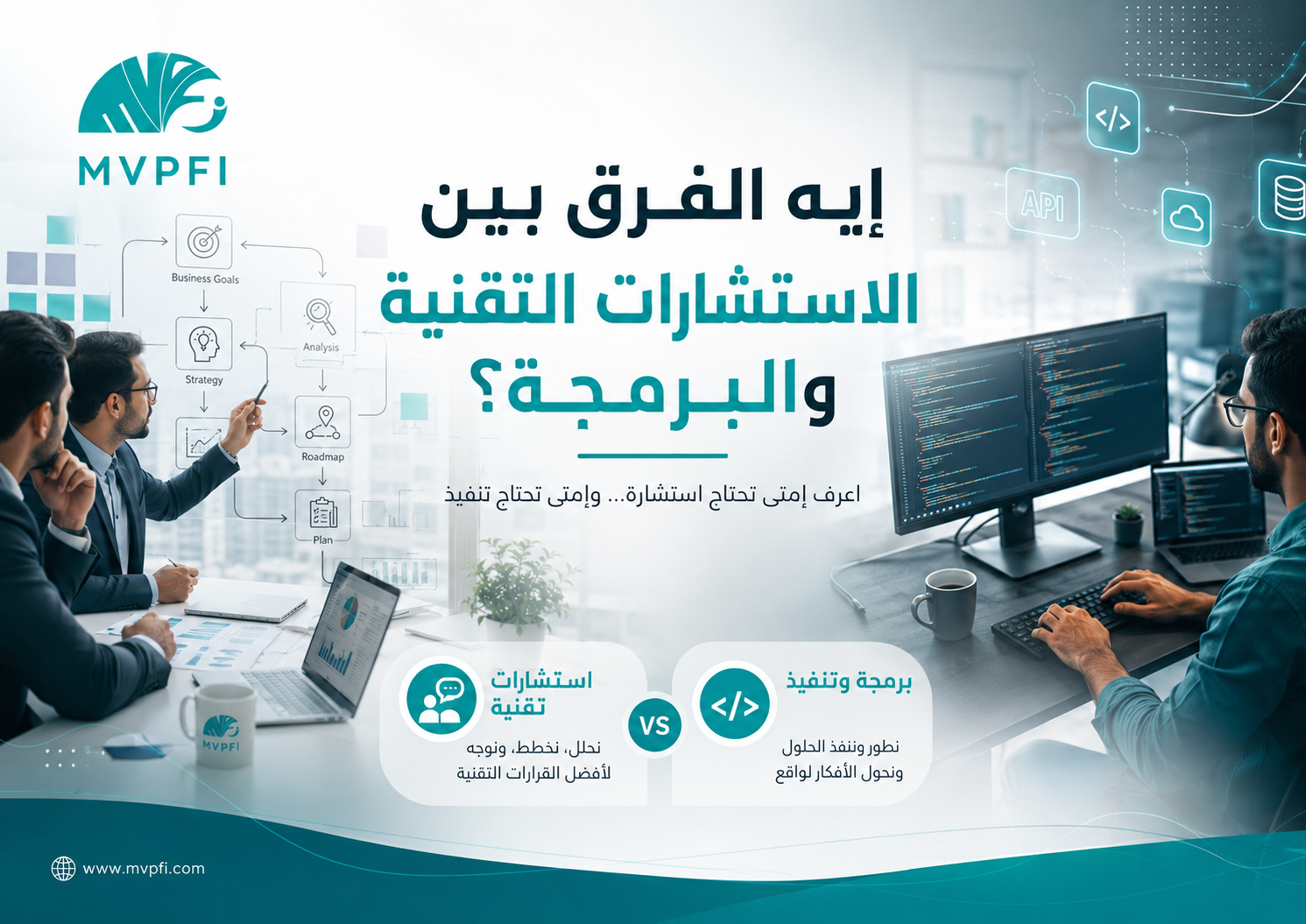
What Is the Difference Between Technical Consulting and Programming?
Technical consulting and programming are not the same thing. Consulting helps you understand what you need, why you need it, and how to execute it correctly. Programming turns the plan and solution into a working system. The difference is like the difference between “designing the road” and “building the road.”
Many companies start a technical project with a direct question: “How much does it cost to build a system?” or “We need a developer to build an app.” But before programming, there is a more important question: Is the problem clear? Is an app really the right solution? Do we need ERP, CRM, a website, or simple automation? Is the current workflow ready to become a system?
This is where technical consulting becomes important. A consultant does not start by writing code. They start by understanding the business, analyzing processes, defining goals, choosing the right solution, and reducing the risk of spending money on a system that does not solve the real problem.
What Is Technical Consulting?
Technical consulting is a service that helps a company understand its real technology needs before execution. A technical consultant analyzes the current situation, listens to management and teams, reviews operations, identifies problems, and then recommends the most suitable solution path.
Technical consulting does not only focus on “which technology should we use?” It connects technology to business goals: increasing sales, reducing waste, improving customer service, organizing operations, connecting departments, or making decision-making easier.
Good technical consulting prevents you from building a large system for a problem that had a simpler solution — or building a small solution for a problem that needs a deeper system.
What Is Programming?
Programming is the execution stage of a technical solution. It means turning analysis, design, and requirements into code, databases, user interfaces, dashboards, integrations, tests, and a system that actually works.
The developer or development team plays a critical role, but they need clear requirements. The clearer the vision and analysis are, the faster, more accurate, and more business-aligned the implementation becomes.
The Core Difference Between Technical Consulting and Programming
The core difference is that technical consulting asks: “What is the right solution?” while programming asks: “How do we build this solution?” Consulting focuses on thinking, analysis, and decision-making. Programming focuses on building, implementation, and operation.
| Point | Technical Consulting | Programming |
|---|---|---|
| Main Role | Analyzing the problem and defining the right solution | Implementing the solution and turning it into a real system |
| Main Question | What do we need? Why? And what is the priority? | How do we build the system? And with which technology? |
| Outputs | Analysis, plan, roadmap, requirements, recommendations | Code, system, application, dashboard, integrations |
| Focus | Business, operations, risks, priorities | Code, databases, interfaces, testing |
| Result | A clearer technical decision with lower risk | A usable digital product |
When Do You Need Technical Consulting Before Programming?
You need technical consulting when the problem is not clear, when the project is large, or when you are worried about investing in a system that will not serve real operations. Consulting is especially useful before building ERP systems, CRM systems, mobile apps, learning platforms, e-commerce stores, or custom internal systems.
You Have an Idea but Do Not Know Where to Start
Consulting helps turn the idea into a clear scope, execution phases, priorities, and expected cost.
You Have Repeated Operational Problems
Such as lost data, delayed reports, weak customer follow-up, inventory errors, or invoicing mistakes.
You Cannot Choose Between Different Solutions
Do you need ready-made software, custom development, ERP, CRM, automation, or integrations? Consulting clarifies the decision.
The Project Affects Many Departments
The more departments and users involved, the more important analysis becomes before execution.
When Do You Need Programming Directly?
You need programming when the requirements are clear, the goal is defined, the process is understood, and the scope or design is ready for execution. In this case, the development team’s role is to build, test, and deliver.
But if programming starts without enough requirement definition, many changes will usually appear during implementation. This delays the project, increases the cost, and may result in a system that does not satisfy users.
Programming without enough analysis is like building a house without architectural drawings: it may start quickly, but it often gets stuck at the first serious decision.
Why Does Confusing Them Cause Problems?
When a client asks for “programming” while they actually need “consulting,” the team starts execution before understanding the real problem. The result may be a beautiful-looking system that does not solve the actual pain point.
The opposite is also true. If a project stays in consulting and analysis forever without execution, ideas will never turn into real value. Success needs both: the right thinking first, then strong implementation.
Execution Before Understanding
Development starts quickly, then many changes appear because the problem was not clearly defined.
Analysis Then Execution
Operations and goals are understood first, then translated into executable requirements.
Measure and Improve
After delivery, usage and results are measured, then the system is improved based on real performance.
What Does a Technical Consultant Provide?
A technical consultant does not simply sell you a specific software product. They help you understand the most suitable technology path for the business. Sometimes the recommendation may even be that the company does not need custom development now, but needs process organization, a ready-made solution, or simple automation.
Current-State Analysis
Reviewing operations, current tools, data, repeated problems, and sources of waste.
Identifying the Real Need
Is the problem in the system, workflow, data, training, or lack of integration?
Choosing the Right Solution
Recommending a ready-made solution, custom development, integrations, CRM, ERP, automation, or phased execution.
Preparing a Roadmap
Prioritizing phases, identifying risks, and clarifying what should be implemented first.
What Does the Programming Team Provide?
The programming team turns the plan and requirements into a digital product. This includes building interfaces, databases, business logic, integrations, permissions, reports, testing, and system launch.
| Execution Area | Role in the Project |
|---|---|
| Frontend | Designing and implementing user interfaces and user experience |
| Backend | Building system logic, databases, permissions, and processing |
| API Integration | Connecting the system to other services such as payment, shipping, CRM, or ERP |
| Testing | Testing features, errors, performance, and user experience before launch |
| Deployment | Publishing the system on the server, configuring settings, and monitoring after launch |
Practical Example: A Company Wants an ERP
Imagine a company says: “We need an ERP.” If programming starts immediately, a large system may be built with sales, inventory, accounting, and HR modules. After months, the company may discover that the team does not use it because the real problem was unclear approval cycles or poor data entry habits.
In technical consulting, the consultant asks questions such as: What is the biggest problem right now? Is inventory inaccurate? Are collections delayed? Are reports weak? Are sales not being followed up? Then the first phase is defined clearly instead of building everything at once.
The real question is not “Should we program an ERP?” The real question is: “Which part of operations needs organization first?”
When Is Consulting More Important Than Programming?
Consulting becomes more important when the technical decision itself is not settled. For example: should we build a mobile app or a website? Should we buy a ready-made system or build custom software? Should we start with CRM or ERP? Do we need a full platform or just a simple landing page?
Before Choosing the Type of System
Choosing a system that is too big or too small for the need wastes time and budget.
Before Writing the Scope
An unclear scope leads to disagreements and many changes during development.
Before an Expensive Project
The higher the cost and risk, the more important analysis becomes before spending the budget.
After a Previous Technical Failure
If you tried a system and it failed, do not start a new one before understanding why the previous one failed.
When Is Programming More Important Than Consulting?
Programming becomes the priority when the vision is clear, requirements are written, designs or scenarios are ready, and the team knows exactly what needs to be built.
In this case, too much consulting may delay execution unnecessarily. It is better to move into development and testing while keeping space for review and improvement.
The Right Way to Execute a Technical Project
The best approach is not “consulting only” or “programming only.” It is an integrated path that starts with understanding, then planning, then execution, then measurement.
Discovery
Understanding goals, processes, audience, problems, and current tools.
Solution Design
Designing the solution, defining phases, writing requirements, and choosing the right technology.
Development
Building interfaces, databases, logic, integrations, reports, and system features.
Testing and Launch
Testing the system, training users, launching, and following up after go-live.
Questions to Ask Before Starting Development
| Question | Why It Matters |
|---|---|
| What problem are we solving? | So you do not build a system that misses the real cause |
| Who is the main user? | Management needs are different from employee or customer needs |
| Which processes will the system support? | To define the project scope and required features |
| What is the priority for the first release? | To avoid turning the project into a long list that delays launch |
| How will success be measured? | To know whether the system created value or was only technically delivered |
| Who will manage the system after launch? | Because system success depends on operation and follow-up, not delivery only |
Common Mistakes When Working With Software Companies
Asking for a Price Before Defining Requirements
A project cannot be priced accurately without understanding scope, features, users, and integrations.
Focusing Only on the Interface
The interface matters, but the system must also solve the process and serve the real user.
Building Everything in the First Version
It is better to launch a clear MVP, then improve gradually based on real usage.
Ignoring Training and Operation
A technically good system may fail if users are not trained to use it.
No Project Owner
There must be someone from the client side responsible for decisions and follow-up.
No Measurement After Launch
If you do not measure usage and results, you will not know whether the project truly succeeded.
Conclusion
Technical consulting and programming complete each other. Consulting helps you choose the right decision, and programming turns that decision into a real product that works inside the business.
If the problem is unclear, the project is large, or the budget matters, start with technical consulting. If the requirements are clear and the scope is defined, move directly into development with a team that can deliver quality, testing, and support.
A successful technical project does not start with code only, and it does not end at delivery only. It starts with understanding the business need and ends with a measurable result.
Start Your Technical Project With the Right Decision Before Spending on the Wrong Execution
MVPFI helps you analyze your needs, define the right solution, prepare a roadmap, write requirements, and then build systems, websites, and applications professionally in a way that serves real business goals.
Frequently Asked Questions
What is the difference between technical consulting and programming?
Technical consulting defines the problem, the right solution, and the execution plan. Programming implements the solution and turns it into a real system, app, or website.
Do I need a technical consultant before hiring a software company?
If the problem is unclear, the project is large, or it affects more than one department, having a technical consultant before development reduces risks and costs.
Can a developer provide technical consulting?
Sometimes yes, but technical consulting requires understanding business, operations, systems, risks, and strategy — not only writing code.
When should I start programming directly?
When the requirements are clear, the scope is defined, the goal is known, and the processes the system will support are understood.
What is the risk of programming without analysis?
You may build a system that does not solve the real problem, or many changes may appear during implementation, causing delays and higher costs.
Is technical consulting a replacement for programming?
No. Consulting helps you choose the right path, but programming is what builds the solution and turns it into a usable product.
What are the main outputs of technical consulting?
Main outputs may include current-state analysis, real needs assessment, solution recommendation, roadmap, execution priorities, and core project requirements.
How can MVPFI help with consulting and programming?
MVPFI helps analyze company needs, design technical solutions, prepare requirements, then build websites, systems, and applications connected to business goals.
Add New Comment