 English
 العربية

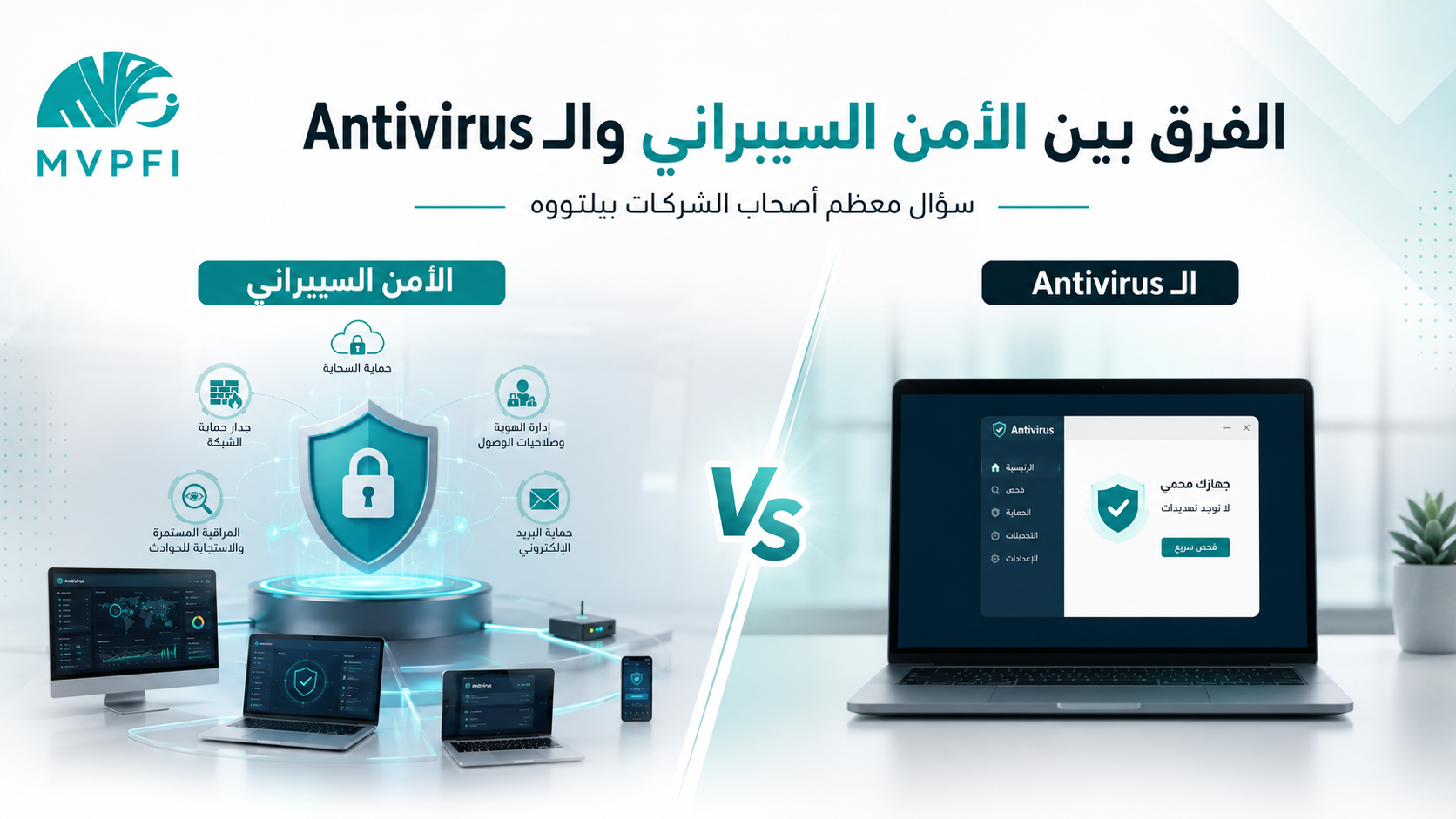
Cybersecurity vs Antivirus — The Question Most Business Owners Get Wrong
Many business owners believe that having antivirus software on company devices means the business is protected. The truth is different. Antivirus is important, but it is only one small part of a much wider protection system called cybersecurity. The difference is like locking one door versus securing the entire building.
When you ask a business owner, “Is your company protected from cyber risks?” the answer is sometimes: “Yes, we have antivirus.” This is where the misunderstanding starts. Antivirus can help protect devices from certain types of malware, but it does not protect the company from every digital risk.
Antivirus alone does not stop phishing emails, weak passwords, wrong file sharing, unsecured Wi-Fi, open permissions, missing backups, or attacks targeting business email accounts. That is why the right question is not only: “Do we have antivirus?” The right question is: “Do we have a complete cybersecurity strategy?”
First: What Is Antivirus?
Antivirus is software designed to detect, block, and remove malicious software from a specific device. It can help protect computers and laptops from viruses, trojans, some malware, suspicious files, and harmful behavior.
In simple terms, antivirus protects the device. It does not automatically manage employee permissions, separate guest Wi-Fi, secure email accounts, enforce strong passwords, create backups, monitor network activity, or define what should happen if a breach occurs.
Antivirus protects a device. Cybersecurity protects the business: devices, networks, data, people, systems, and processes.
What Is Cybersecurity?
Cybersecurity is a complete system for protecting a business from digital risks. It is not one tool. It includes policies, procedures, technologies, employee awareness, monitoring, access control, network protection, backup, and incident response.
Cybersecurity asks bigger questions than “Does this device have a virus?” It asks: What are the company’s most important data assets? Who can access them? Are accounts protected? Is the network secure? Are employees trained against phishing? Are backups working? Do we know what to do if an attack happens?
The Core Difference Between Cybersecurity and Antivirus
The core difference is scope. Antivirus is one tool inside endpoint protection. Cybersecurity is a complete strategy for managing digital risk across the whole business.
You may have strong antivirus software, but your business can still be exposed if email is not protected, passwords are weak, backups are missing, Wi-Fi is unsecured, permissions are too open, or employees are not trained to recognize phishing.
| Point | Antivirus | Cybersecurity |
|---|---|---|
| Scope | Usually protects a device from malware | Protects the whole business: devices, networks, data, people, and systems |
| Main Goal | Detect and block harmful files or behavior | Reduce digital risk and manage protection, detection, response, and recovery |
| Phishing Protection | May help partially depending on the product | Includes employee awareness, email security, and access policies |
| Access Control | Does not manage full company permissions | Includes identity, user permissions, and access management |
| Backup | Not a backup solution | Includes backup, recovery, and business continuity planning |
| Incident Response | May isolate a file or show an alert | Includes a full plan to respond to incidents and reduce damage |
Why Antivirus Alone Is Not Enough
Many modern attacks do not start as a clear virus. They can start with a fake email, a WhatsApp link, a PDF attachment, a stolen password, an outdated device, or a weak Wi-Fi network. In these cases, antivirus alone may not be enough to stop the risk.
Phishing Attacks
An employee may click a fake link and enter login details voluntarily. The issue here is not only malware; it is email security, employee awareness, and multi-factor authentication.
Weak Passwords
If admin panels, email accounts, or business systems use weak passwords, antivirus will not solve the problem by itself.
Open Permissions
If every employee can access every file, one compromised account can create major damage across the business.
Missing Backups
If files are encrypted, deleted, or corrupted, antivirus cannot replace a proper backup and recovery strategy.
A Simple Example: A Company Has Antivirus but Is Still Not Secure
Imagine a company that has antivirus on all devices, but the same Wi-Fi network is used by employees and guests, email accounts do not use multi-factor authentication, employees have wide access to shared files, backups are done manually once a month, and the router admin password has not changed in years.
Does this company have antivirus? Yes. Is it truly cybersecure? No. The weaknesses are not only in viruses. They are in access control, networks, email, backup, monitoring, and response.
Real protection does not depend on one tool. It depends on multiple layers that prevent, detect, and reduce damage.
What Does Business Cybersecurity Include?
Cybersecurity for businesses includes several layers. Each layer reduces a different type of risk. Together, these layers provide stronger protection than relying on antivirus alone.
Employee Awareness
Training employees to recognize phishing emails, suspicious links, unsafe attachments, weak passwords, and risky data sharing.
- Anti-phishing awareness
- Clear usage policies
- Reduced human error
Policies and Procedures
Defining who can access which system, how permissions are granted, how data is backed up, and how incidents are handled.
- Access control
- Incident response plan
- Backup and recovery
Tools and Technologies
Antivirus, firewall, email protection, endpoint monitoring, updates, encryption, and network security controls.
- Endpoint security
- Network protection
- Monitoring and alerts
Does That Mean Antivirus Is Not Important?
No. Antivirus or endpoint protection is still important. The problem is not using antivirus; the problem is treating it as the only security solution.
Antivirus should be part of a wider security plan that also includes email protection, network security, access control, backups, software updates, monitoring, and employee awareness.
Antivirus is important — but it is not a complete cybersecurity strategy.
Signs Your Business Is Relying Only on Antivirus
No Multi-Factor Authentication
Email, admin panels, and business systems are protected only by passwords, without an extra verification layer.
No Organized Backup
Backups are irregular, untested, or stored on the same devices that could be affected by an attack.
Unclear Permissions
Most employees can access files and systems they do not actually need for their work.
No Real Monitoring
No one reviews connected devices, alerts, login attempts, unusual behavior, or risky activity.
Minimum Cybersecurity Layers for a Small Business
Not every small business needs a huge security operations center. But there are basic layers that should not be ignored. These fundamentals can significantly reduce risk and create a strong starting point.
| Layer | What to Apply | Why It Matters |
|---|---|---|
| Devices | Antivirus or endpoint protection with regular updates | Reduces malware and device-level attack risks |
| Accounts | Strong passwords and multi-factor authentication | Prevents unauthorized access even if a password leaks |
| Network | Firewall, secure Wi-Fi, and separate guest network | Limits access to internal devices and reduces exposure |
| Data | Regular backups and recovery testing | Protects against deletion, ransomware, and data loss |
| People | Employee awareness against phishing and unsafe sharing | Many attacks begin with a simple human mistake |
| Monitoring | Review alerts, login attempts, and connected devices | Helps detect issues before they become major incidents |
Practical Steps to Start Now
If your business currently relies only on antivirus, start with clear and realistic steps. The goal is not to make work complicated. The goal is to build security layers that match your company size, budget, and risk level.
Review Devices and Accounts
Make sure every device has updated protection, and that important accounts use strong passwords and multi-factor authentication.
Separate Networks and Permissions
Separate guest Wi-Fi, and give employees access based on actual work needs, not habit or convenience.
Prepare Backup and Response
Make backups regular, test recovery, and define what should happen if a device, email account, or system is compromised.
Conclusion
Antivirus is an important tool, but it is not the same as cybersecurity. It belongs to the device protection layer, while cybersecurity covers everything that protects the business digitally: people, networks, accounts, data, systems, monitoring, and incident response.
If your company relies only on antivirus, it may be protected from part of the problem but exposed to other serious risks such as phishing, weak passwords, open permissions, missing backups, or poor network security.
The smart decision is not to remove antivirus. The smart decision is to place it inside a complete cybersecurity strategy that fits your business size and real risk level.
Move From One Security Tool to a Clear Cybersecurity Strategy
MVPFI helps you review device security, networks, email, access permissions, backup, and technical infrastructure to build a protection plan that matches your business size and actual risks.
Frequently Asked Questions
Is antivirus enough to protect a business?
No. Antivirus is important, but it is not enough on its own. A business also needs network security, access control, email protection, backups, employee awareness, and monitoring.
What is the difference between cybersecurity and antivirus?
Antivirus is software that protects devices from certain types of malware. Cybersecurity is a complete system that protects data, networks, accounts, systems, people, and business processes.
Do I still need antivirus if I have cybersecurity?
Yes. Antivirus or endpoint protection is an important part of cybersecurity, but it should work alongside other layers, not alone.
What is the biggest risk of relying only on antivirus?
The biggest risk is a false sense of security. Devices may be partially protected, while email, networks, passwords, permissions, and backups remain weak.
What are the most important cybersecurity layers for small businesses?
Important layers include device protection, strong passwords, multi-factor authentication, secure networks, regular backups, employee awareness, and monitoring.
Is cybersecurity expensive for small businesses?
Not necessarily. A business can start with strong basics that fit its budget, then improve the security program gradually as the company grows.
How do I know if my business needs a security review?
If you do not know who has access, have no organized backup, do not use multi-factor authentication, or do not review networks and devices, your business needs a security review.
How can MVPFI help with cybersecurity?
MVPFI helps assess risks, review devices, networks, access permissions, backup, and technical infrastructure, then implement a practical protection plan for the business.
Add New Comment