 English
 العربية

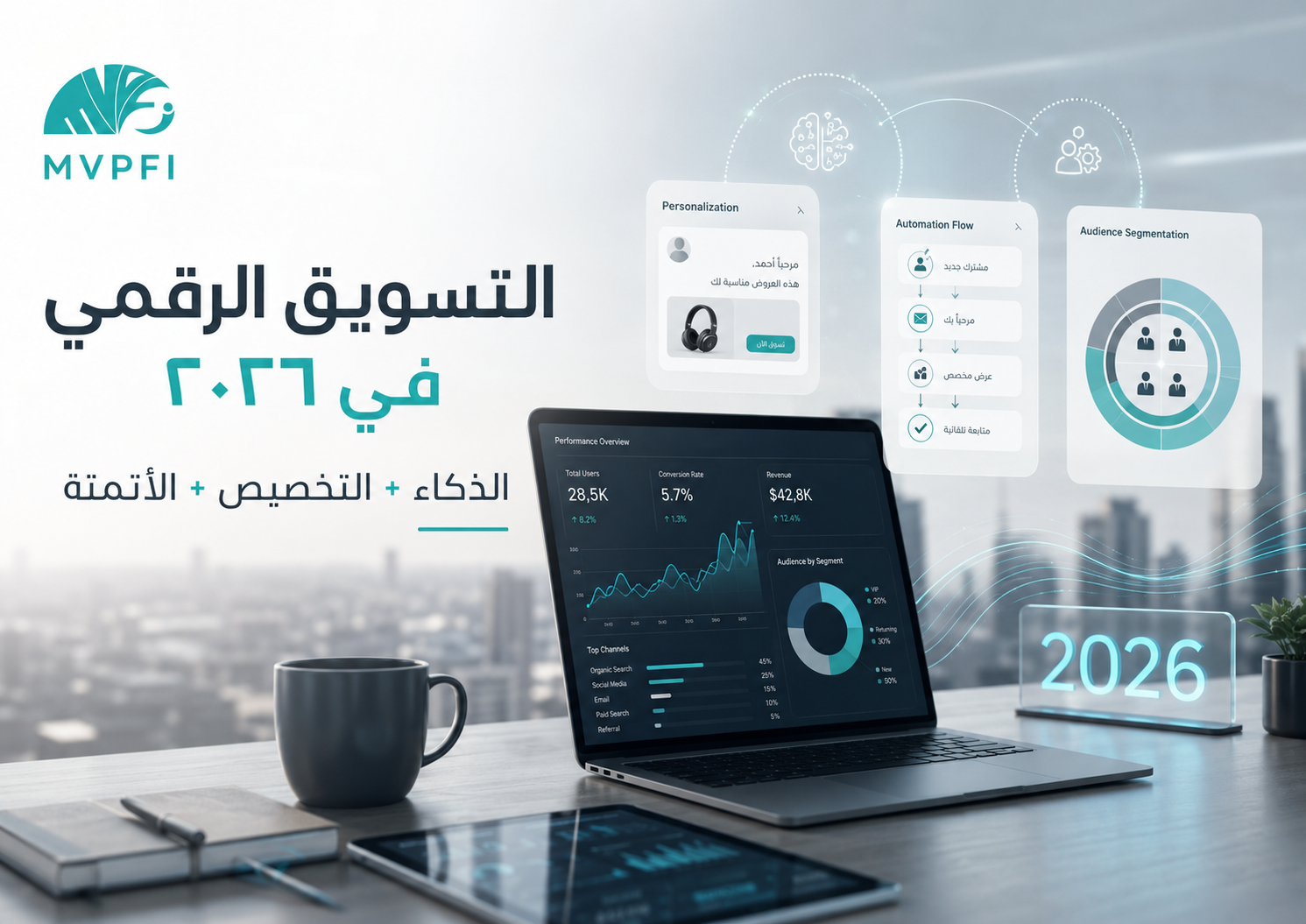
Digital Marketing in 2026 Is Moving Toward Intelligence, Personalization, and Automation — Where Should You Start?
Digital marketing in 2026 is no longer just about social media posts and paid ads. The major shift is toward smarter marketing: using artificial intelligence, customer understanding, personalized messages, automated follow-up, and clear measurement at every step.
If your company still handles digital marketing the same way it did in previous years — generic posts, ads without tracking, the same message for every customer, and surface-level reports — you will most likely spend more and achieve less.
In 2026, the competition is not about who publishes more. It is about who understands the customer faster, responds at the right time, sends the right message, and turns data into decisions. This is where AI Marketing, Marketing Automation, and Personalization become essential.
What Does Digital Marketing Mean in 2026?
Digital marketing in 2026 means using digital channels together with data, artificial intelligence, and automation to build a smarter customer journey. The goal is not only to reach the customer, but to understand them, segment them, communicate with the right message, and follow up until they become an actual customer.
The major difference is that marketing can no longer operate separately from sales and customer service. Ads, websites, social media, CRM, WhatsApp, email, and reporting need to work together as one connected system.
In 2026, successful marketing is not only about generating more traffic. It is about turning the right visit into a relationship and a buying decision.
Why Is Marketing Moving Toward Intelligence, Personalization, and Automation?
Customers are exposed to a massive amount of content and ads every day. Generic messages are no longer enough, and the competition for attention is becoming harder. That is why companies need marketing that understands who the customer is, what they want, what stage they are in, and which message is most relevant to them.
Trend One: Artificial Intelligence in Marketing
Artificial intelligence does not mean replacing the entire marketing team with a tool. The right use of AI is to make it an assistant for the team: speeding up research, suggesting ideas, analyzing data, writing drafts, segmenting audiences, and identifying performance improvement opportunities.
Faster Audience Analysis
AI can help understand customer behavior, repeated questions, objections, and the topics that matter most to the audience.
More Accurate Content Ideas
Instead of creating random content, AI can help generate content angles connected to real customer problems.
Better Ad Optimization
AI can help test different hooks, analyze creative performance, and suggest messages that fit each customer segment.
Faster Reporting
Instead of reading many numbers manually, AI can summarize performance and extract strengths, weaknesses, and next actions.
Trend Two: Personalization Instead of Generic Messages
Personalization means you do not send the same message to everyone. A new customer needs a different message from an existing customer. A customer who visited the pricing page needs a different follow-up from someone who only engaged with an educational post.
| Customer Type | Suitable Message | Goal |
|---|---|---|
| New customer who does not know the brand | Educational content and trust-building | Increase awareness and interest |
| Customer who visited the website more than once | Clear value offer or case study | Encourage contact or request |
| Customer who sent a message but did not buy | Follow-up based on objections and FAQs | Reduce hesitation and increase conversion |
| Customer who already purchased | After-sales support or relevant upsell | Retention and higher customer value |
Trend Three: Marketing Automation and Follow-Up
Automation does not mean sending annoying messages randomly. Proper automation means building smart steps that help the customer move through their journey and help your team avoid forgetting follow-ups.
For example, when a customer fills out a form on the website, they automatically enter the CRM, receive a welcome message, the sales representative gets notified, and a reminder is triggered later if no follow-up happens.
Lead Enters the System
From an ad, website form, WhatsApp, phone call, or social media message.
Automatic Classification
The lead source, interest, stage, and priority are identified based on data and behavior.
Smart Follow-Up
Messages, reminders, and sales tasks are triggered based on customer stage, not random timing.
Trend Four: Content Is No Longer About Quantity — It Is About Perspective and Trust
With the spread of AI tools, producing large amounts of content has become easy. But more content does not always mean better content. In 2026, brands without a clear point of view may disappear inside a sea of similar content.
What is needed is content that demonstrates expertise, addresses real customer problems, provides practical examples, and clearly expresses the brand’s personality. Do not publish only because the calendar says there should be a post today. Publish because you have real value to add.
The content that wins in 2026 is content that teaches, proves expertise, and builds trust — not content that only fills the page.
Trend Five: SEO Is Evolving Into AEO and AI Answer Visibility
Search is no longer only about ranking on the first page of Google. With the rise of intelligent answer engines, your content needs to be structured, trustworthy, clear, and easy for search engines and AI systems to understand and reference.
Content That Answers Clear Questions
Build content around real customer questions, not only broad keywords.
Strong Article Structure
Use clear headings, tables, FAQs, short definitions, and content that is easy to understand.
Proof of Expertise
Add examples, use cases, practical experience, and trust signals instead of generic statements.
Connect Content to Conversion
Do not make the article only a reading experience. Connect it to the next step: contact, download, booking, or request.
Where Should You Start If Your Company Is Not Ready Yet?
Do not start by buying many tools or launching huge campaigns. Start by building the system that makes marketing measurable and improvable. The right beginning is data, customer journey, content, and follow-up.
| Stage | What to Do | Expected Result |
|---|---|---|
| Current-state analysis | Review channels, ads, website, messages, and results | Know where effort and budget are being wasted |
| Data collection | Connect forms, campaigns, and WhatsApp to a clear data source | Track every lead source and customer stage |
| Audience segmentation | Segment customers by interest, stage, and behavior | More accurate messages and higher conversion |
| Simple automation | Start with welcome messages, follow-up reminders, and team alerts | Reduce lost customers and improve response speed |
| Measurement and improvement | Track KPIs weekly and improve content and campaigns | Decisions based on data, not assumptions |
Step 1: Build an Organized Customer Database
You cannot run smart marketing without organized data. If your customers are scattered across WhatsApp messages, spreadsheets, comments, emails, and calls, you will lose the ability to analyze and follow up properly.
The practical starting point is having a CRM or a clear customer database that records: customer name, source, interest, current stage, last contact, responsible team member, and result.
Without a CRM or follow-up system, even a successful ad campaign can turn into a lost opportunity because of delayed replies or forgotten follow-ups.
Step 2: Define the Customer Journey
Before automation, you need to understand the customer journey. What happens from the moment a customer sees an ad or reads an article until they become a customer? Where do they stop? What are their common objections? What do they need at each stage?
Awareness Stage
The customer discovers the problem or hears about your company for the first time.
Consideration Stage
The customer compares solutions and needs content that proves trust and expertise.
Decision Stage
The customer needs a clear offer, fast response, and removal of objections.
Step 3: Use AI for Research and Analysis, Not Only Copywriting
A common mistake is using AI only to write many posts. The stronger use is to use it for market understanding, audience analysis, performance analysis, and better testing.
Analyze Customer Messages and Comments
Collect repeated questions and objections, then use them to build more accurate content and campaigns.
Extract Insights From Data
Analyze previous campaigns to understand which messages, audiences, and channels had the strongest impact.
Test Multiple Angles
Use AI to generate hooks, titles, and copy variations, then test them instead of relying on one opinion.
Summarize Reports
Turn long performance numbers into clear points: what happened, why it happened, and what decision comes next.
Step 4: Start With Small Automation Instead of a Complex System
You do not need to start with a huge automation setup. Start with the simplest pain points: first response, lead registration, follow-up reminders, customer classification, or sending relevant content based on the customer stage.
| Problem | Simple Automation | Impact |
|---|---|---|
| Delayed response to messages | Smart welcome message with initial request classification | Better customer experience from the first moment |
| Forgotten follow-ups | Automatic sales reminder after a defined period | Fewer lost opportunities |
| Hard to know lead source | UTM tracking and form connection with CRM | Know which channels generate real results |
| Generic messages for all customers | Segment customers by interest and stage | Higher conversion rate |
Step 5: Connect Marketing With Sales
One of the biggest reasons marketing results become weak is that marketing generates leads, but sales does not follow up quickly, does not know the lead source, or does not record the result of the conversation.
In 2026, it is not enough to say “the campaign generated messages.” The more important questions are: how many messages became qualified leads? How many leads received follow-up? How many proposals were sent? How many deals closed? And what was the cost of each actual customer?
Do not measure marketing only by the number of messages. Measure it by qualified leads, response speed, and conversion into sales.
The Most Important Digital Marketing KPIs in 2026
The metrics you need are not just reach and likes. The most important metrics are the ones that connect marketing activity to business results.
| KPI | What It Measures |
|---|---|
| Cost per Qualified Lead | The cost of generating a truly suitable potential customer |
| Lead to Sale Conversion Rate | The percentage of leads that become actual sales |
| Customer Acquisition Cost | The total cost of acquiring a new customer |
| Marketing ROI | The real return from marketing compared to total cost |
| Response Time | How fast the team responds after the first customer contact |
| Channel Quality | The quality of customers coming from each channel, not only the quantity |
Mistakes to Avoid in 2026
Moving toward intelligence and automation does not mean using many tools randomly. Some mistakes can make marketing more complicated instead of more effective.
Using AI Without Strategy
If you use AI to produce more content without a goal, you will increase noise without increasing results.
Automating a Bad Experience
If the customer journey is bad, automation will only make it faster, not better.
Ignoring Privacy and Data
Personalization should be based on secure data and clear consent, not random use of customer information.
Measuring Surface-Level Numbers
Likes and messages matter, but they are not enough if you do not know how many real customers came from them.
Separating Marketing From Sales
You cannot improve marketing without knowing what happens after the customer reaches the sales team.
Copying Competitors
What works for a competitor may not work for your audience, stage, offer, or sales model.
A 30-Day Plan to Start Marketing for 2026
If you want to start practically, do not start with everything at once. Follow a simple 30-day plan to build a foundation that can scale.
Review and Analyze
Review current channel performance, campaigns, website, messages, and customer sources.
Organize Data
Prepare a CRM or organized sheet, and connect every lead to its source, stage, and owner.
Test AI and Personalization
Use AI to analyze objections, create messages for each segment, and prepare more accurate content.
Automate and Measure
Apply simple automation for response and follow-up, then measure improvements in response speed and conversions.
Practical Example: A B2B Service Company
A service company wants new clients in 2026. Instead of running only generic ads, it starts by analyzing the audience, building a clear service page, launching a targeted campaign, entering every lead into CRM, then sending relevant content based on the customer stage.
| Part | Practical Application |
|---|---|
| Content | Articles and pages explaining problems, solutions, and case studies |
| Ads | Targeted campaigns for a specific audience with different messages by problem |
| CRM | Registering the lead, source, stage, and follow-up owner |
| Automation | Follow-up messages and team reminders based on customer stage |
| Dashboard | Measuring best customer sources, acquisition cost, and close rate |
Conclusion
Digital marketing in 2026 is moving toward intelligence, personalization, and automation. But the starting point is not buying an AI tool or increasing ad budgets. The starting point is understanding the customer, organizing data, connecting marketing with sales, then using AI and automation to improve performance.
A company that starts building a smart marketing system now will get more value from every pound or dollar it spends. A company that continues with generic content and ads disconnected from sales will spend more for weaker results.
Start small but smart: organize your data, understand the customer journey, personalize your messages, automate follow-up, and measure results clearly.
Turn Marketing From Scattered Posts and Campaigns Into a Smart, Measurable System
MVPFI helps you build a digital marketing strategy based on data, CRM, automation, artificial intelligence, and performance analysis — while connecting marketing with sales to achieve clearer results and more stable growth.
Frequently Asked Questions
What are the most important digital marketing trends in 2026?
The most important trends include artificial intelligence, message personalization, marketing automation, connecting marketing with sales, and using data analytics for more accurate decisions.
Will AI replace marketers?
Not necessarily. But it will change the way marketers work. Marketers who use AI for analysis, testing, and optimization will be stronger than those who rely only on traditional methods.
What does personalization mean in marketing?
Personalization means delivering the right message, offer, or content based on customer type, interest, and stage in the buying journey, instead of sending the same message to everyone.
What is marketing automation?
Marketing automation means using systems to execute repeated steps such as first response, follow-up reminders, customer classification, and sending relevant messages based on customer behavior.
Where should a small company start?
Start by organizing customer data, connecting lead sources, defining the customer journey, then applying simple automation and measuring results weekly.
Do I need a CRM for marketing in 2026?
Yes, especially if you receive leads from multiple channels. A CRM helps prevent lost customers, track lead sources, and follow each opportunity until sale.
What are the most important digital marketing KPIs?
Important KPIs include Cost per Qualified Lead, Lead to Sale Conversion Rate, Customer Acquisition Cost, Marketing ROI, and Response Time.
How can MVPFI help improve digital marketing?
MVPFI helps build digital marketing strategies, organize data, connect CRM, implement automation, use AI workflows, and create dashboards to measure real performance.

Add New Comment