 English
 العربية
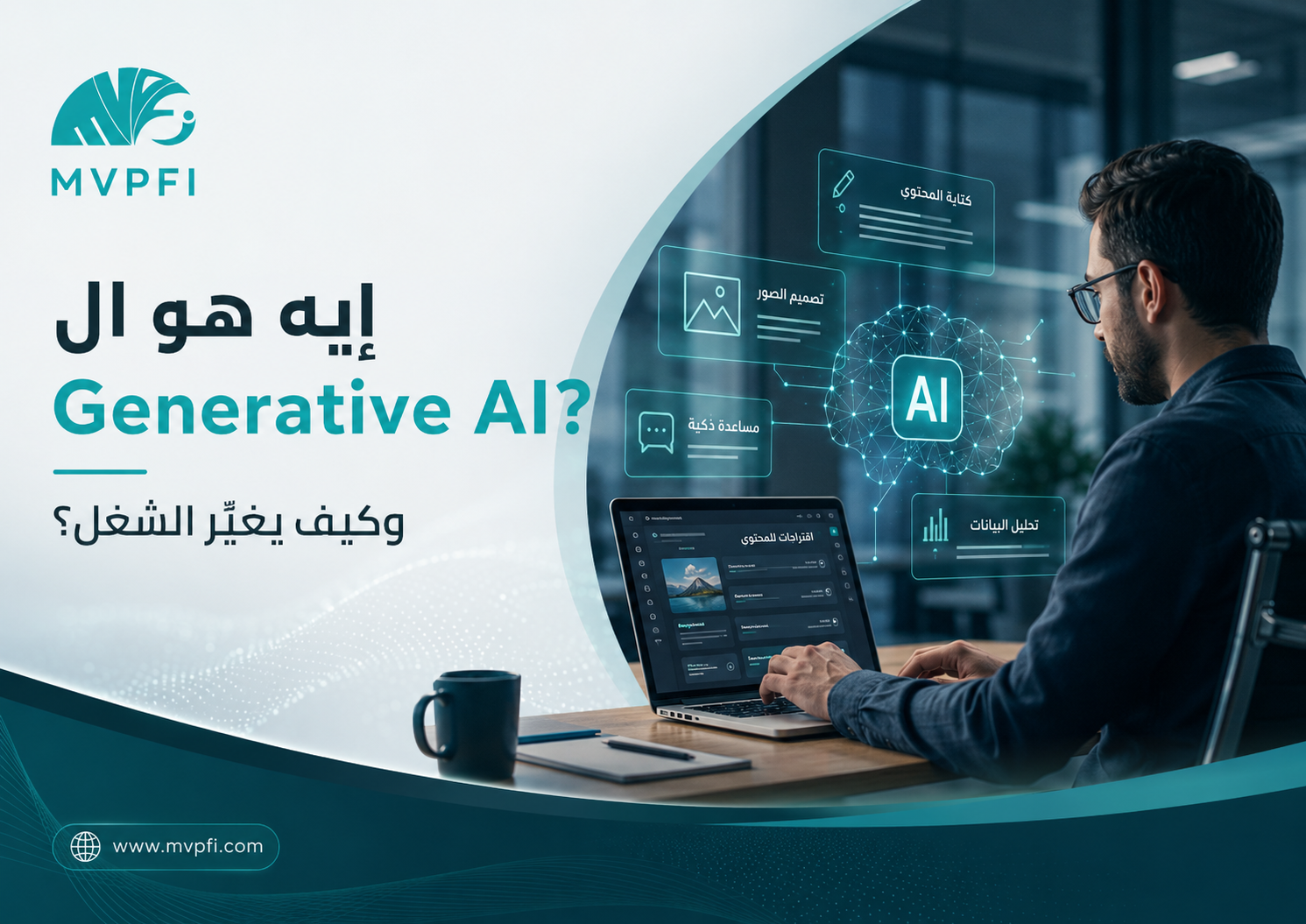
What Is Generative AI and How Is It Changing the Way We Work?
Generative AI is no longer just a tool for writing text or creating images. It is a real shift in how work gets done inside companies, because it helps teams produce ideas, content, code, reports, messages, analysis, and first drafts faster when used correctly.
Over the past few years, artificial intelligence has become part of almost every field: marketing, sales, software development, customer service, management, education, design, and data analysis. But the type of AI that has clearly changed daily work is Generative AI.
The idea is simple: these tools do not only analyze data or follow fixed commands. They can generate new outputs such as text, images, code, ideas, plans, summaries, presentations, messages, scenarios, and even strategic drafts.
What Is Generative AI?
Generative AI is a type of artificial intelligence that can create new content based on the data it was trained on and the instructions it receives from the user.
In other words, instead of only asking a system for information, you can ask it to write an ad draft, summarize a meeting, suggest a content plan, generate code, analyze a problem, or prepare a sales message. It is called “generative” because it produces something new rather than only choosing from ready-made answers.
Generative AI does not replace human thinking. It speeds up the first-draft stage and helps people start from a stronger point.
How Is Generative AI Different From Traditional AI?
Traditional AI often focuses on analysis, classification, prediction, or decision-making based on data. Generative AI focuses on creating new outputs that people can use, edit, review, or improve.
| Comparison | Traditional AI | Generative AI |
|---|---|---|
| Main Function | Analyze, classify, or predict | Generate content, ideas, or new outputs |
| Example | Identify whether a customer is likely to buy | Write a personalized message for that customer |
| Business Use | Insights, decisions, and analytics | Content creation and knowledge-work automation |
| Human Role | Review the result or decision | Guide, edit, review, and approve the output |
How Does Generative AI Change Work?
The biggest impact of Generative AI is not that it performs one task only. Its real impact is that it changes how work starts. Instead of starting from a blank page, employees can start from a useful draft and improve it.
This reduces time wasted on repetitive tasks and allows teams to focus more on judgment, quality, creativity, strategy, and decision-making.
Practical Examples of Generative AI in Companies
Generative AI is not limited to content creation. It can support many departments when there is a clear goal and human review.
Marketing and Content Creation
Writing campaign ideas, captions, articles, video scripts, ad copy, content plans, and rewriting content for different audiences.
Customer Service
Preparing smart replies, summarizing conversations, classifying complaints, suggesting solutions, and building knowledge bases.
Software Development
Helping developers write code, explain errors, suggest solutions, create documentation, and generate initial tests.
Management and Reports
Summarizing meetings, turning discussions into action items, preparing reports, writing proposals, and analyzing strengths and weaknesses.
Sales
Writing follow-up messages, personalizing offers, analyzing customer objections, and preparing scripts for calls or WhatsApp.
Data Analysis
Explaining numbers, summarizing tables, extracting important indicators, and suggesting useful questions for management.
Does Generative AI Replace Employees?
The better question is not: will AI replace employees? The more accurate question is: which tasks will become faster and easier, and which skills will become more important?
Generative AI usually changes the shape of a role more than it replaces the entire role. An employee who used to spend a long time writing a draft or summarizing information can now do it faster, then focus on review, quality, judgment, and business context.
| Before Generative AI | After Generative AI |
|---|---|
| Long time spent writing the first draft | Faster first draft that needs review and improvement |
| Manual search across notes and reports | Faster summaries and extraction of key points |
| Few versions of messages and content | Multiple versions customized for different audiences |
| Difficulty turning ideas into clear wording | Ready suggestions that can be adjusted to fit the brand |
| Heavy dependence on repetitive manual tasks | More focus on decisions, creativity, and quality |
What Skills Become More Important With Generative AI?
Using Generative AI effectively requires new skills. The most important skill is not knowing the name of the tool, but knowing how to guide it, evaluate its results, and connect it to a clear goal.
Prompt Engineering
Writing clear instructions so the tool understands the goal, context, audience, tone, and required output format.
Critical Thinking
Reviewing results carefully instead of accepting any AI output as final, because AI can make mistakes or produce generic answers.
Domain Knowledge
Understanding the field itself, because experts can evaluate outputs and detect weak or inaccurate results.
Workflow Design
Knowing where AI fits into the workflow: research, writing, review, summarization, automation, support, or analysis.
How Can Companies Use Generative AI Safely?
Using Generative AI without clear rules can create problems, especially when employees enter sensitive data or depend on outputs without review.
Define Allowed Use Cases
Make it clear which tasks employees can use AI for, and which tasks require approval or review.
Protect Sensitive Data
Do not enter customer data, contracts, financial numbers, passwords, or sensitive internal information into untrusted tools.
Require Human Review
Any important content, report, message, or decision should be reviewed by a responsible person before approval or publishing.
Document Usage Rules
Create prompt templates, review rules, and examples of correct and incorrect usage for every team.
Biggest Mistakes Companies Make With Generative AI
The problem is not usually the tool itself, but how it is used. Some companies use Generative AI randomly and end up with weak, unsafe, or off-brand results.
Using It Without a Clear Goal
Using AI only because it is trending leads to scattered results and does not create real business value.
Copying Outputs Without Review
AI outputs need review and editing to match the audience, brand voice, and accurate company information.
Entering Sensitive Data
Sharing customer data, contracts, or financial information in public tools can create privacy and security risks.
Ignoring Team Training
Teams need to learn how to write good prompts, review outputs, and know when not to use AI.
Generative AI in Marketing: From More Content to Smarter Content
In marketing, Generative AI does not only mean producing more posts. The real value appears when teams use it to understand audiences, test different angles, personalize messages, and speed up campaign execution.
It can help write ad ideas, divide content by customer journey stage, generate multiple versions of the same message, analyze comments, and prepare automated replies that match the brand tone.
Stronger AI-powered marketing is not about publishing more. It is about understanding faster and personalizing messages with better precision.
Generative AI in Software Development: Assistant, Not a Replacement for Understanding
In software development, Generative AI can help developers write parts of code, explain errors, suggest solutions, generate tests, and improve documentation. But it does not replace good architecture or deep understanding of the project.
AI-generated code must be reviewed, tested, and checked against security and performance standards. Depending on it without understanding may create difficult bugs, security issues, or solutions that do not fit the system architecture.
| Weak Use | Professional Use |
|---|---|
| Copying code without understanding | Using AI as an assistant with review and testing |
| Generic solutions that ignore the project | Guiding the tool with system context and architecture |
| Ignoring security | Reviewing permissions, inputs, and possible vulnerabilities |
| Not documenting what changed | Using AI to help generate clear documentation |
How Should Your Company Start Using Generative AI?
The right starting point is not buying many tools. It is choosing small, clear use cases and measuring their impact on time, quality, and productivity.
Choose Simple Use Cases
Start with clear tasks such as meeting summaries, content drafts, customer support replies, or internal reports.
Build Prompt Templates
Prepare reusable templates for each team to produce consistent outputs that are easier to review.
Create Review Rules
Define who reviews outputs, what quality standards are required, and what should never be published directly.
Measure the Impact
Compare time before and after, output quality, team satisfaction, and the number of tasks accelerated.
Is Generative AI Suitable for Every Company?
Yes, but at different levels. A small company can use it to improve content and customer service. A medium company can add it to CRM or internal systems. A larger company may need governance policies, integrations, permissions, and customized models.
The key is to avoid random usage. Every company should define where AI creates real value and where it may create risks or inaccurate results.
Conclusion
Generative AI is a type of artificial intelligence that can generate new content, ideas, and outputs based on user instructions. Its real impact is not only in replacing manual tasks, but in changing how work starts and accelerating knowledge-based work.
The companies that benefit most from it are the ones that use it inside clear workflows, protect their data, require human review, train their teams, and connect AI usage to real business goals.
Generative AI will not automatically make every company successful, but it will give a clear advantage to companies that use it with awareness, structure, and measurable outcomes.
Turn AI From a Random Tool Into a Clear Productivity Workflow
MVPFI helps businesses analyze operations, identify the best AI use cases, build prompt templates, connect AI with CRM and ERP systems, design dashboards, and automate repetitive tasks in a safe and organized way.
Frequently Asked Questions
What is Generative AI?
Generative AI is a type of artificial intelligence that can create new content such as text, images, code, summaries, ideas, and responses based on user instructions.
What is the difference between Generative AI and traditional AI?
Traditional AI often focuses on analysis, classification, or prediction, while Generative AI focuses on creating new outputs that can be used or edited.
Does Generative AI replace employees?
In most cases, it changes tasks more than it replaces entire roles. It helps speed up drafts, summaries, and automation while humans remain responsible for direction, review, and decision-making.
What are the main business uses of Generative AI?
Main uses include content writing, customer service, message analysis, meeting summaries, software development, report generation, sales support, and automation.
Is Generative AI safe to use?
It can be safe when companies set clear rules, avoid entering sensitive data into untrusted tools, and review outputs before approving or publishing them.
What is Prompt Engineering?
Prompt Engineering is the skill of writing clear and specific instructions for AI tools to get better results that match the goal, context, and required format.
How can a small business start using Generative AI?
A small business can start with simple tasks such as content drafts, meeting summaries, customer replies, or comment analysis, then measure time saved and output quality.
How can MVPFI help apply Generative AI?
MVPFI helps companies choose the right use cases, build AI workflows, connect AI with systems, prepare prompts, design dashboards, and automate repetitive tasks safely.
Add New Comment